Alchemy in Parma between science, spirituality and tradition: Hermetic paths from the Middle Ages to the early modern age
Abstract
This article explores the presence of alchemy in the city of Parma from the Middle Ages to the early modern age, with particular attention to the monastic context, the Farnese court and the Ancient Apothecary (Spezieria) of San Giovanni Evangelista. Through the analysis of texts, therapeutic practices and significant figures, a cultural landscape emerges in which alchemy, medicine, philosophy and religion intertwine, contributing to the formation of a complex, interdisciplinary body of knowledge.
1. Introduction: alchemy as a liminal knowledge
For centuries alchemy represented a system of thought poised between experimental science, religious symbolism and spiritual aspiration. Not reducible to the search for the transmutation of metals alone, it implied a vision of the world ordered by correspondences between macrocosm and microcosm, in which the purification of matter coincided with the regeneration of the soul. In Parma, a city of ancient religious institutions and home to a refined court culture, alchemy found fertile ground to develop in various forms: doctrinal, operative and speculative.
2. Medieval origins: monasteries, libraries and the transmission of knowledge
In the medieval context, alchemical knowledge circulated mainly within monasteries, the places entrusted with preserving classical and scientific culture. The Benedictine Abbey of San Giovanni Evangelista, founded in the 10th century, played a fundamental role in transmitting philosophical and technical texts, including manuscripts of medicine and alchemy from the Arab and Latin worlds. The abbey library, enriched by precious illuminated codices, held commentaries on texts by Galen and Avicenna, and perhaps also Latin versions of the Turba Philosophorum.
3. The Spezieria of San Giovanni Evangelista: between pharmacopoeia and Hermetic laboratory
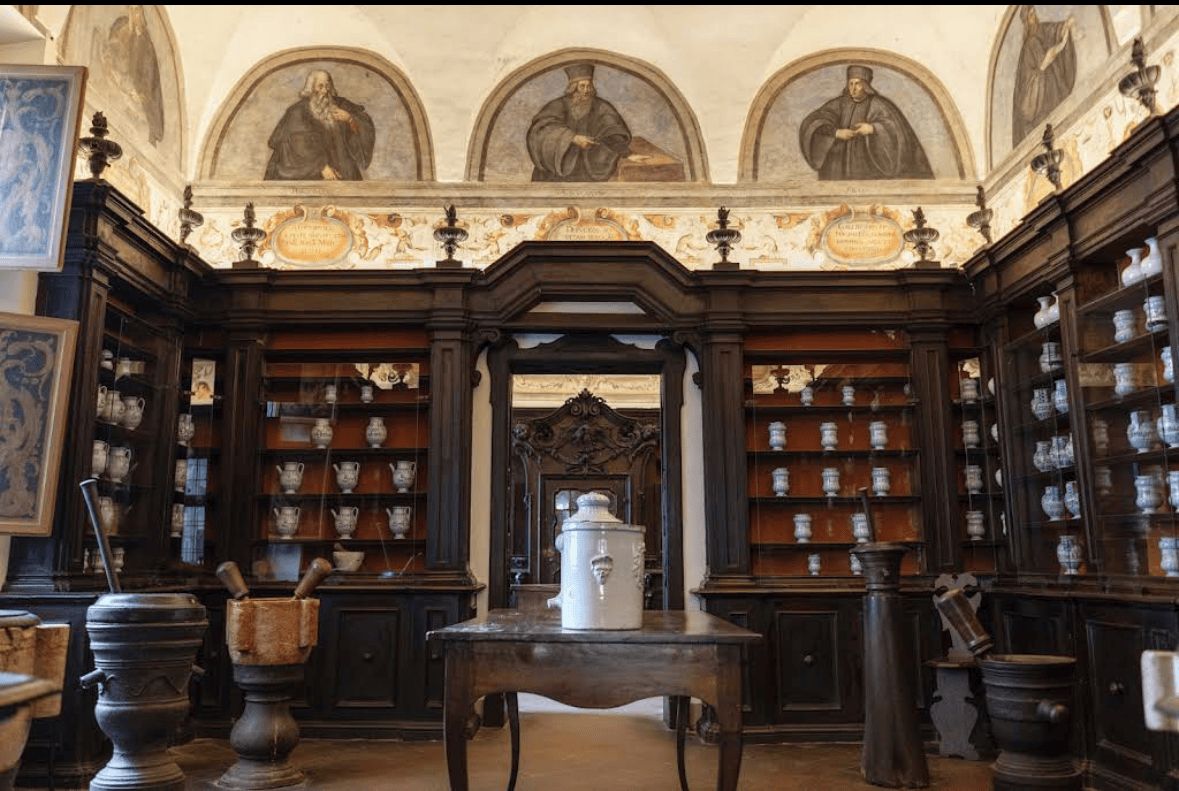
Founded and documented as early as 1201, the Ancient Apothecary of San Giovanni Evangelista is the operational heart of the alchemical-medical tradition in Parma. Within the monastic complex it had a twofold function: on the one hand it supplied remedies to the sick and to the brethren; on the other it served as a true alchemical laboratory, where complex preparations were tested according to the precepts of natural science and Paracelsian medicine.
The Spezieria comprised three main rooms: the Hall of Ampoules, the Hall of Mortars and the Hall of Scales, reflecting an ordered and measurable conception of herbal practice. The instruments used (alembics, retorts, furnaces, glass and ceramic vessels) were similar to those described in alchemical manuals of the 16th and 17th centuries. The symbolic context was explicit: crosses, six-pointed stars, astrological seals and plant motifs decorated the walls, alluding to a sacred knowledge that transcended the therapeutic function.
Analysis of some alchemical-therapeutic preparations
The Spezieria of San Giovanni is documented as a place where remedies were produced which, though belonging to the medical register, reflected the symbolic and operative universe of alchemy:
- Melissa Water (Aqua Melissae): obtained by distilling fresh leaves of Melissa officinalis (lemon balm) with Eastern spices. It was considered a "balm of the spirits", effective against melancholy and nervous disorders. It also symbolised the balance of the humours, a fundamental principle of Galenic medicine reinterpreted in an alchemical key.
- Scorpion Oil (Oleum Scorpionis): a remedy obtained by macerating scorpions in olive oil, often with added resins and minerals. Used against poisons and pestilential fevers, it symbolically represented "the poison that cures poison", in line with the alchemical principle of transmutation through opposition.
- Cinchona Elixir: a tonic preparation based on cinchona bark (Cinchona officinalis), mixed with alcohol, saffron and potable gold (aurum potabile). The addition of gold symbolised perfection and incorruptibility, qualities the remedy was meant to impart to body and soul.
- Celestial Rose Water: a version distilled on astrologically favourable days, with ground pearls and rose water, used in purification rituals. The rose, a Marian symbol and a symbol of spiritual perfection, took on both mystical and therapeutic value.
These preparations highlight the interweaving of empirical pharmacology and a sacred conception of nature, consistent with the Hermetic vision that attributed subtle powers to mineral and plant substances.
4. The Renaissance and the Farnese court: alchemy and natural philosophy
In the 16th century, with the advent of the Renaissance and the spread of Hermeticism, alchemy enjoyed renewed cultural prestige. The Farnese court in Parma, particularly under Ottavio and Alessandro Farnese, promoted philosophical, scientific and occult studies. Printers such as Girolamo Scotto contributed to the publication of Hermetic and Paracelsian texts, encouraging the circulation of works by Agrippa von Nettesheim, John of Rupescissa and Paracelsus. The cultural climate of the court allowed scholars, physicians and apothecaries to integrate alchemical practices into therapeutic protocols and cosmological models.
5. The 17th century: medicine, alchemy and Paracelsianism
In the 17th century alchemy evolved in a medical-chemical direction. The thought of Paracelsus, who saw in nature a code readable through the signatura rerum, inspired a new generation of iatrochemists. Although there is no direct evidence of famous alchemists living permanently in Parma, the Spezieria and the University (founded in 1601) showed growing interest in chemistry and pharmaceutical materials.
The medical vocabulary of the time included alchemical concepts such as spiritus, corpus, sulphur, mercurius and sal, following the Paracelsian tripartition. The practice of multiple distillations, the separation of active principles and the production of elixirs testified to a transformation of alchemical knowledge in a medical-therapeutic direction, while preserving its symbolic foundation.
6. The decline of classical alchemy: rationalism and secularisation
With the advent of the Enlightenment and the development of modern chemistry (from Boyle to Lavoisier), alchemy progressively lost its scientific authority. In Parma, however, some residual forms of alchemy survived in religious and collecting circles until the 19th century. The Spezieria of San Giovanni was secularised in 1798 during the Napoleonic suppressions, but continued to operate intermittently until 1900. Today it is a museum open to visitors, preserving the original instruments, documents and recipe books that bear witness to centuries of practical alchemical knowledge.
7. Conclusions
The history of alchemy in Parma shows the persistence of a composite body of knowledge that crossed the centuries, adapting to spiritual, scientific and political contexts. From the medieval monasteries to the Renaissance court and the apothecaries of the 17th and 18th centuries, alchemy functioned as a form of total knowledge: physical and metaphysical, empirical and symbolic. The study of the preparations of the Spezieria of San Giovanni reveals its most tangible, yet also its most mysterious, side.
Essential bibliography
- Baldi, Bernardino. Cronica de gli alchimisti. Venice, 1611.
- Cattin, Giuliano. San Francesco del Prato: simboli, storia e rinascita. Parma: Diabasis, 2021.
- Giavarini, Giovanni. “Bodoni e il libro alchemico.” In: Archivio tipografico parmense, vol. 4, 2006.
- Thorndike, Lynn. A History of Magic and Experimental Science. New York: Columbia University Press, 1923.
- Zambelli, Paola. L’ambigua natura della magia: filosofia e scienza nel Rinascimento italiano. Milan: Il Saggiatore, 1992.
- Ministero della Cultura. Antica Spezieria di San Giovanni Evangelista. cultura.gov.it
- Il Giornale dell’Arte. A Parma tra alambicchi e albarelli. 2022. ilgiornaledellarte.com