Göbekli Tepe: new perspectives on the origins of monumental civilization
1. Introduction
Göbekli Tepe, in the region of the Anatolian plateau, about 18 km north-east of the modern city of Şanlıurfa, is one of the most extraordinary sites for the study of late prehistory (Schmidt, 2006; Dietrich et al., 2012). First discovered in 1963 during a survey by the University of Chicago and Istanbul University, it was initially interpreted as a medieval cemetery. Only with the start of systematic excavations led by Klaus Schmidt from 1995 was the true significance of the site understood (Schmidt, 2010).
Chronologically, Göbekli Tepe falls within the Pre-Pottery Neolithic A (PPNA) and then the Pre-Pottery Neolithic B (PPNB), covering a span from about 9600 BC to about 8000 BC. The results of the excavations have revolutionised theories on the social and cultural evolution of the earliest human communities.
2. Stratigraphy and construction phases
Stratigraphic investigations carried out between 1995 and 2014 have made it possible to distinguish at least three main levels of activity:
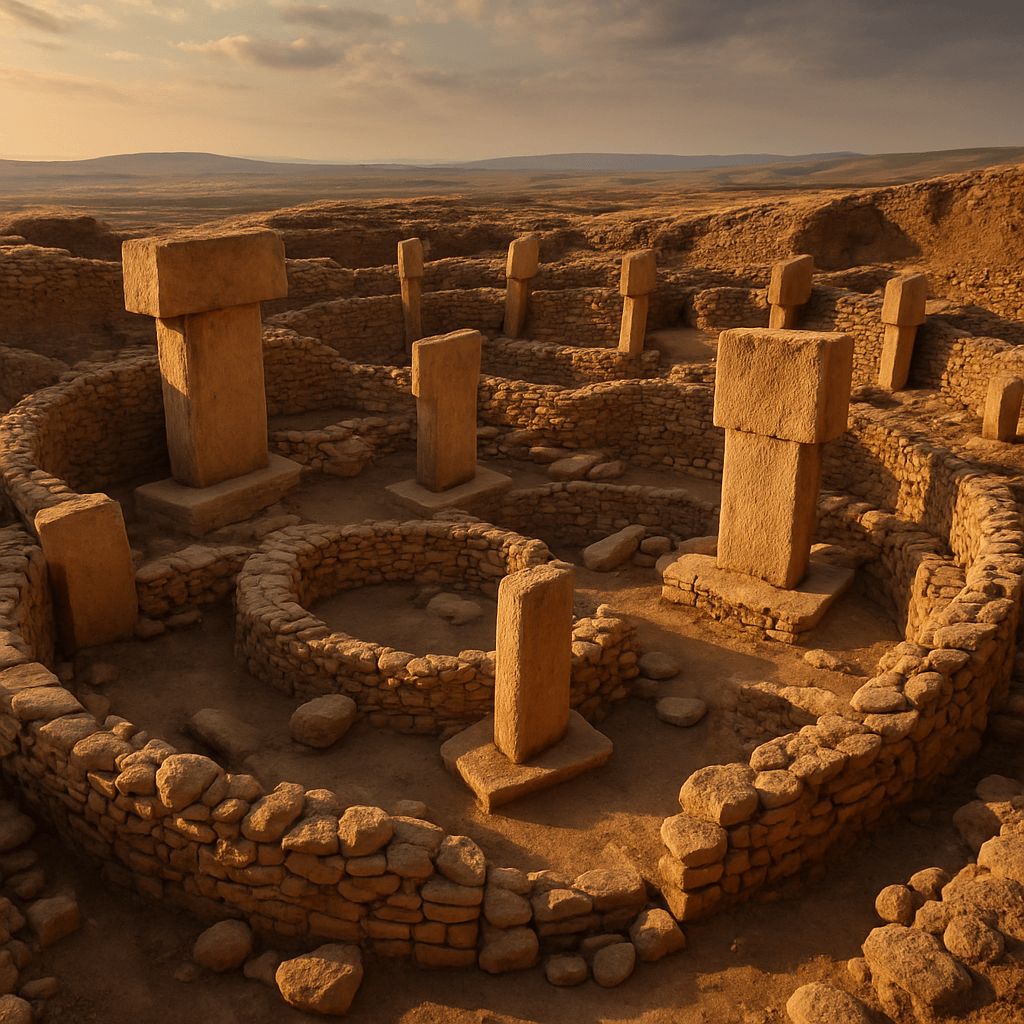
- Level III (c. 9600–8800 BC): the oldest and most monumental, characterised by large megalithic enclosures with T-shaped pillars.
- Level II (c. 8800–8000 BC): smaller structures with smaller pillars, sometimes incorporated into rectangular or trapezoidal buildings.
- Level I: corresponds to the intentional backfilling of the site, which took place around 8000 BC (Dietrich et al., 2012; Notroff et al., 2014).
3. Architecture and symbolic iconography
The most distinctive features of Göbekli Tepe are the imposing monolithic pillars carved from limestone, some of which reach 5.5 metres in height and an estimated weight of 10–20 tonnes (Schmidt, 2006). These pillars are decorated with reliefs depicting a wide range of fauna, including snakes, lions, foxes, wild boar, vultures and insects. Some pillars also bear abstract motifs, such as geometric patterns and enigmatic symbols (Peters & Schmidt, 2004).
The pillars are often interpreted as stylised anthropomorphic figures, given the arms and hands carved on some of them (Dietrich et al., 2017). This suggests that they may have represented ancestors, divine figures or spiritual entities within a complex prehistoric cosmology.
4. Ritual function and social implications
The function of Göbekli Tepe is the subject of intense academic debate. The prevailing hypothesis holds that the site was a ceremonial centre of great regional importance, intended to bring together scattered groups of hunter-gatherers for seasonal rituals (Schmidt, 2010).
The presence of abundant faunal remains, especially of gazelle, points to the possibility of large-scale ritual feasting (Peters & Schmidt, 2004; Dietrich et al., 2012). These practices of social aggregation may have encouraged the emergence of more complex forms of cooperation and social organisation.
Göbekli Tepe also provides significant evidence for the hypothesis that the need to coordinate the construction of monumental structures may have preceded, or even stimulated, the adoption of agriculture (Dietrich et al., 2019).
5. Intentional burial of the site
Around 8000 BC, the builders of Göbekli Tepe themselves decided to bury the monumental enclosures. This burial process, apparently systematic and deliberate, has preserved the monuments remarkably well for more than 10,000 years (Notroff et al., 2014). The reasons for this act remain unknown, but they may be related to profound cultural or religious changes in the region during the transition to settled farming societies.
6. Göbekli Tepe in its regional context
Göbekli Tepe is not an isolated site. Recent excavations and archaeological surveys have identified many other contemporary complexes on the Anatolian plateau, such as Karahan Tepe, Sefer Tepe and Hamzan Tepe (Karul, 2020). These sites share many architectural and iconographic features, suggesting the existence of a vast Neolithic megalithic culture that has so far been underestimated.
7. Conclusions
Göbekli Tepe forces us to reconsider the relationship between economy, religion and social organisation in human evolution. Rather than emerging as a consequence of agricultural sedentism, the construction of monumental structures may have been a primary driver of social complexity.
Bibliography
- Clare, L. (2020). Göbekli Tepe, Turkey: A brief summary of research at a new World Heritage Site (2015–2019). e-Forschungsberichte des Deutschen Archäologischen Instituts.
- Dietrich, O., Heun, M., Notroff, J., Schmidt, K., & Zarnkow, M. (2012). The Role of Cult and Feasting in the Emergence of Neolithic Communities: New Evidence from Göbekli Tepe, South-eastern Turkey. Antiquity, 86(333), 674–695.
- Dietrich, O., Notroff, J., Dietrich, L. (2019). Gathering, Feasting, and Monumentality: Radiocarbon Data Reveal Early Neolithic Social Dynamics at Göbekli Tepe. Proceedings of the National Academy of Sciences, 116(31), 15362–15365.
- Dietrich, O., Notroff, J., & Schmidt, K. (2017). Feasting, Social Complexity and the Emergence of the Early Neolithic of Upper Mesopotamia: A View from Göbekli Tepe. In E. Banning (Ed.), Early Neolithic Settlement and Society (pp. 85-110). University of Toronto Press.
- Kromer, B., & Schmidt, K. (1998). Two Radiocarbon Dates from Göbekli Tepe, South Eastern Turkey. Radiocarbon, 40(2), 849-850.
- Karul, N. (2020). The T-shaped Pillars and Enclosures of Karahan Tepe. Paléorient, 46(2), 83–99.
- Notroff, J., Dietrich, O., & Schmidt, K. (2014). Building Monuments – Creating Communities: Early Monumentality in the Near East. In J. Osborne (Ed.), Approaching Monumentality in Archaeology (pp. 83–105). State University of New York Press.
- Peters, J., & Schmidt, K. (2004). Animals in the Symbolic World of Pre-Pottery Neolithic Göbekli Tepe, South-Eastern Turkey: A Preliminary Assessment. Anthropozoologica, 39(1), 179–218.
- Schmidt, K. (2006). Sie bauten die ersten Tempel: Das rätselhafte Heiligtum der Steinzeitjäger. München: C.H. Beck.
- Schmidt, K. (2010). Göbekli Tepe – The Stone Age Sanctuaries: New Results of Ongoing Excavations with a Special Focus on Sculptures and High Reliefs. Documenta Praehistorica, 37, 239–256.