Polygonal masonry
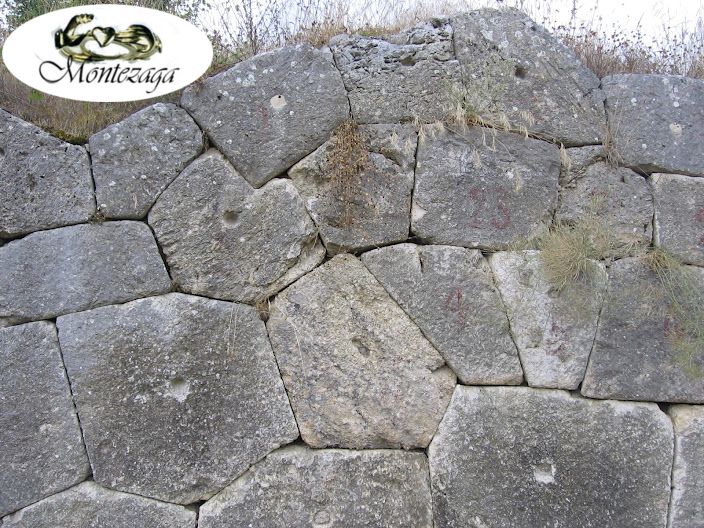 What may look like ordinary walls are one of the most incredible unsolved mysteries of archaeology. These walls, also called "Cyclopean", have nothing to do with the familiar Roman walls made of perfectly squared, rectangular stone blocks laid regularly in courses, that is, in superimposed horizontal lines, the so-called opus quadratum. These walls are called polygonal precisely because they are made of enormous, irregularly cut stone blocks whose surfaces fit together perfectly, like the pieces of a jigsaw puzzle. Their joints are so incredibly precise that you cannot even slip a sheet of paper between them. Archaeology classifies polygonal walls into four different styles, or manners, supposedly reflecting the evolution of the technique over time:
- In the First manner the boulders are used as found in nature, unworked or only roughly shaped, with wide gaps filled with chips and wedging fragments.
- In the Second manner the boulders are chosen with greater care and roughly worked, especially on the bedding surfaces and the visible face. The joints are more precise and the gaps, still filled with chips and rubble, are smaller. This technique was used on slopes, where the boulders were set against the ground for stability.
- In the Third manner the stone is worked so that the contact surfaces match perfectly, without gaps; the visible faces are perfectly flat, and the polygonal blocks fit one another exactly. Care is taken that the bedding surfaces are not too steeply inclined.
- In the Fourth manner the bedding surfaces tend to become horizontal, though still discontinuous, and the blocks tend towards a rectangular shape. Sometimes this tendency depends on the natural characteristics of the stone used, when it tends to split along parallel planes.
This classification is widely used, even though it has very little basis. It is clear that the first manner is nothing more than a simple dry-stone wall requiring no design, while the second and third manners require careful planning, and what distinguishes them is the precision of the cutting and laying technique. The fourth manner has nothing to do with the polygonal technique; if anything, from a design point of view, it should be linked to the technique of squared blocks in horizontal courses used by the Greeks and Romans. It is equally obvious that polygonal masonry has nothing to do with Roman building techniques and is not more primitive than opus quadratum; on the contrary, it is far more advanced. This is shown by the fact that, after major earthquakes, polygonal walls are still standing in many towns in central Italy, unlike Roman walls. One example is the polygonal walls of Alba Fucens, which are still intact despite the terrible earthquake that devastated the Fucino plain in 1915, unlike the Roman remains in the town. The walls held precisely because they were designed according to principles that make them earthquake-resistant. The blocks of polygonal walls behave like the pieces of an elastic system able to sway without collapsing, both because of their particular interlocking and the absence of binder (mortar), and because of the meticulous choice of stone weights, heavier in the upper rows, which exploit a so-called pre-compression effect.
These remarkable structures raise many questions. When were these walls built? Which peoples had the knowledge to design a system so difficult to build, so elegant in appearance and so incredibly functional? How were the stones worked so perfectly and, above all, how was it possible to lay stone blocks weighing hundreds of kilos, fitting them perfectly together according to such an intricate construction scheme?
We can give ourselves few answers. We see no point in bringing up the usual hundreds of men pushing, pulling, lifting with jute ropes, cutting with crude tools and polishing the surfaces with sand to make them fit perfectly, as "official" science usually does when it tries to give an easy explanation for a difficult question. In our view it is far more sensible to say that, to this day, we have not the slightest idea how constructions of this kind could have been built in remote times, belonging to an antiquity so little known to us today, yet tremendously fascinating.
Anyone interested in seeing these marvellous works with their own eyes can visit the so-called Cities of Saturn in Lazio (Alatri, Anagni, Arpino, Atina and Ferentino) or Alba Fucens in Abruzzo, or take a short trip to nearby Crete or to faraway Peru (Machu Picchu, Cuzco).
Bibliography:
- I Segreti delle Antiche Città Megalitiche, Giulio Magli, Newton Compton Editori
- Opera Poligonale, it.wikipedia.org