Santa Brigida - Sanctuary of the Madonna Addolorata
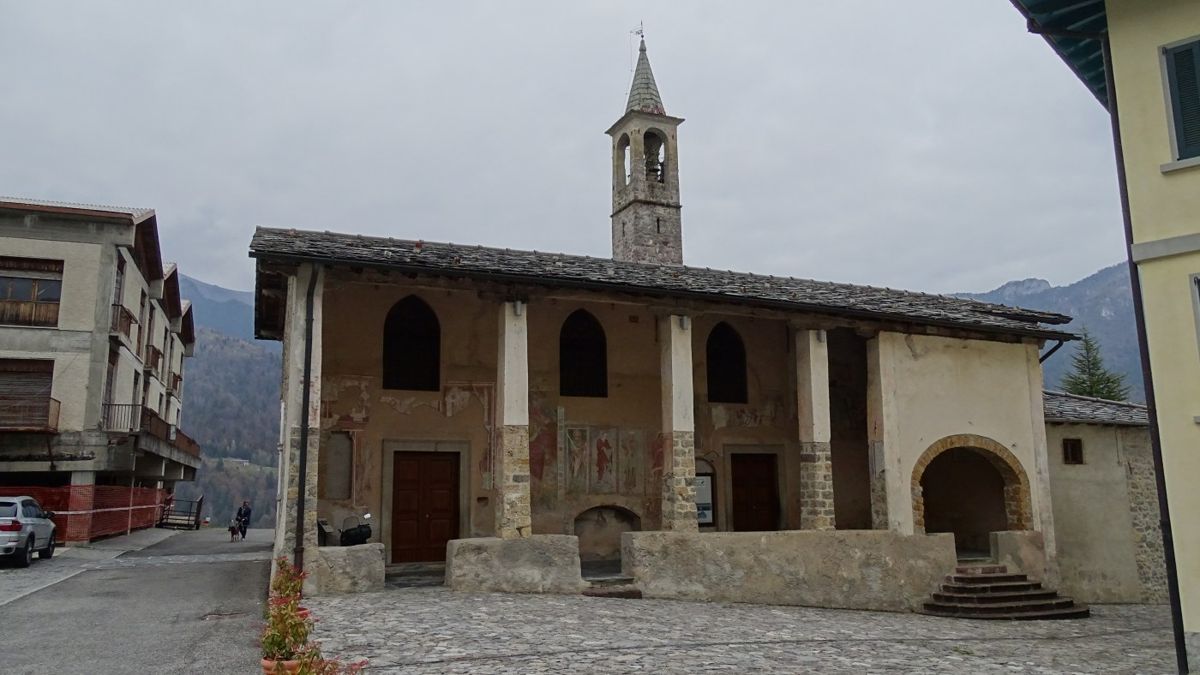
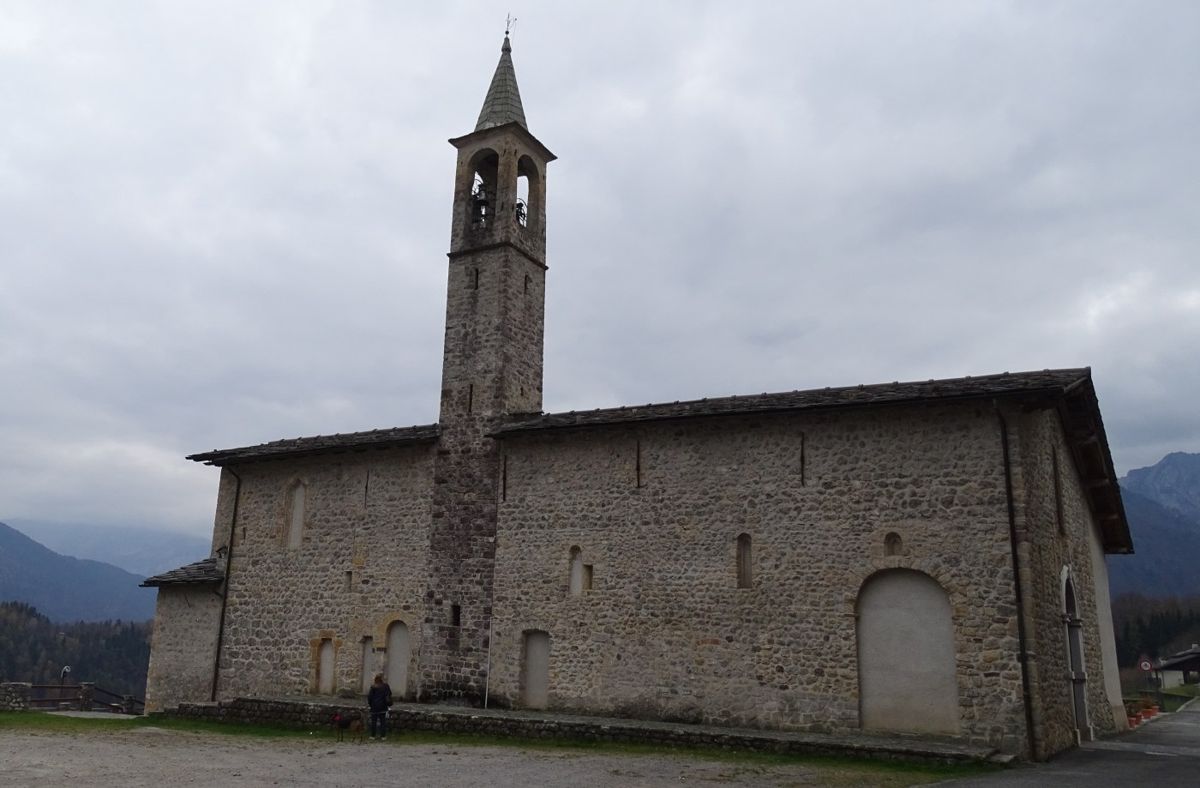
The original chapel dates from the 10th century and may have been built on the remains of an earlier pagan sacred building, probably of Celtic origin. The present building is the result of a series of transformations over about a thousand years, with various enlargements and embellishments reflecting its role as the "mother church" of the Valle Averara. Having separated from the pieve of San Pietro at Primaluna in Valsassina, the church of Santa Brigida became, during the 14th century, the first parish of the ancient Valle Averara.
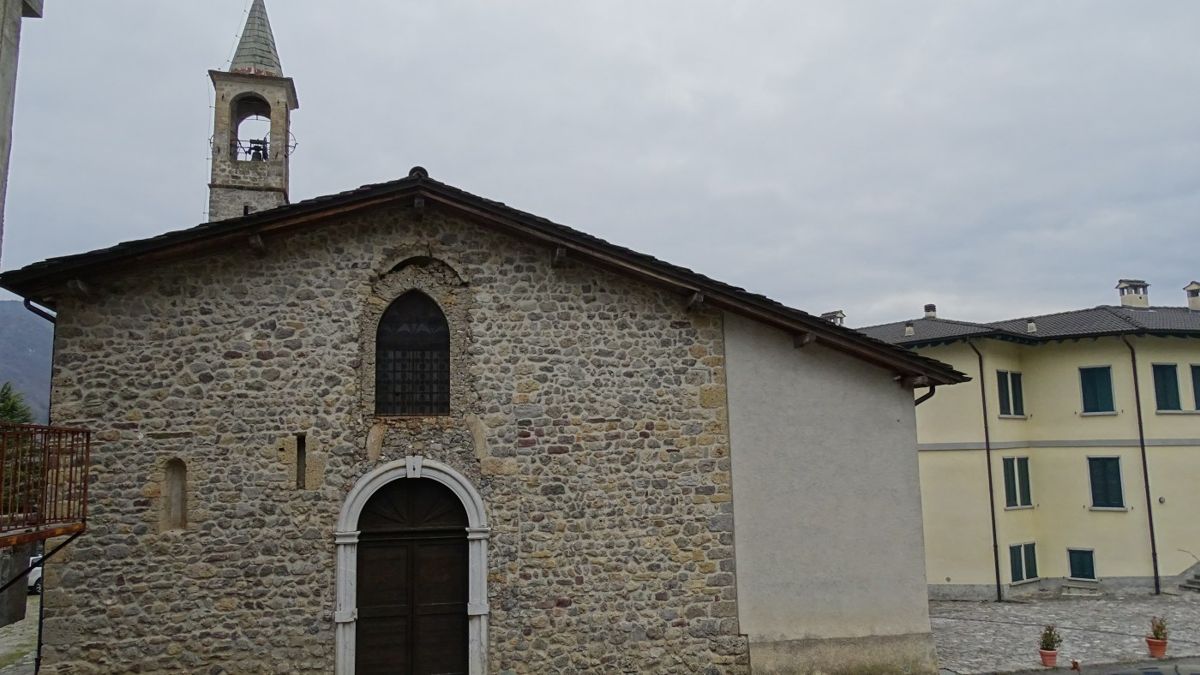
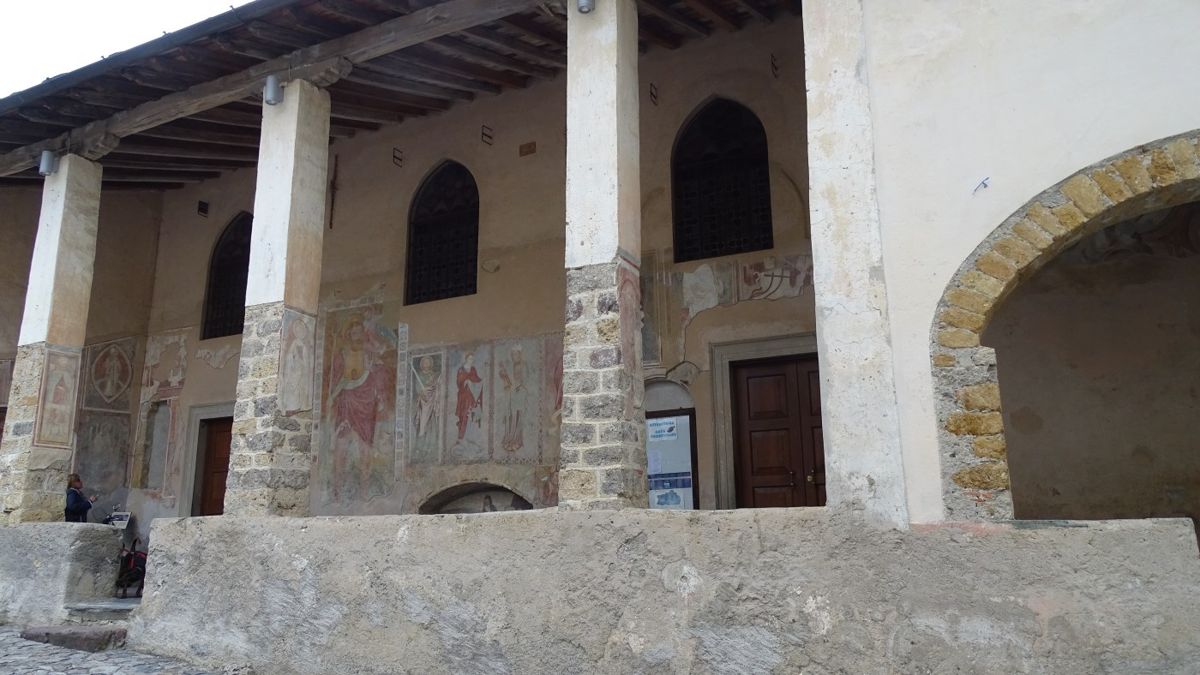
The building has a single nave divided into five pointed-arch bays supported by stone pillars; the gabled roof rests on decorated wooden beams and exposed boarding. Two balustrades in polychrome marble separate the nave from the presbytery, whose vault is decorated with Baroque stucco. The bell tower, with a pyramidal spire, is partly incorporated into the church at its base and has a small belfry with four openings. On the south side is a portico covered by the slope of the church roof, supported by three pillars and almost entirely decorated with frescoes. These frescoes, like those adorning the interior walls, date from the 15th century and can be attributed to local fresco painters, including Pietro de Asenelis (portico cycle) and Angelo Baschenis (paintings in the chapel of San Nicola da Tolentino).
After the new parish church was built, the old church took the new title of Sanctuary of the Madonna Addolorata (Our Lady of Sorrows).
The ancient community of the Valle Averara, settled in the mountains on the border with the Valtellina and Valsassina, in a world of transhumance of people, goods and animals that made the mountains places of constant passage and exchange rather than barriers, saw the church of Santa Brigida rise in very ancient times; over time its name was given to the municipality.
Over time this church became one of the seven curate chaplaincies dependent on the mother church of San Pietro at Primaluna in Valsassina, as recorded in the cartulary attributed to Goffredo da Bussero. A deed drawn up by the notary Antonio della Torre of Primaluna on 7 April 1368 states that in the provostship of the pieve of San Pietro at Primaluna there were already seven "chaplains who have the care of souls for themselves". These chaplains of the curate churches lived at their own churches, steadily consolidating their separation from the mother church. Among these churches were Santa Brigida of Averara and Santa Maria of Valtorta.
In turn, over the centuries, the churches of the Valle Averara would separate by episcopal decree from the mother church of Santa Brigida: the churches of Santa Margherita at Cusio and Sant'Ambrogio at Ornica on 26 July 1456, San Giovanni Battista at Mezzoldo in June 1523, San Giacomo at Averara on 23 October 1566 and San Bartolomeo at Cassiglio in 1611. Its ancient dependence on the church of San Pietro at Primaluna meant that the church of Santa Brigida, like the whole Valle Averara, was part of the diocese of Milan and followed the Ambrosian rite, as it still does today. Unusual is its dedication to the Irish Saint Brigid of Kildare (c. 453-524), abbess and patron of Ireland, a saint of a Celtic world that, through the name Brigid, also harks back to ancient deities. She is a saint of a mountain world of farmers and herders, remembered in ancient tales and legends. Our church of Santa Brigida was built on high ground above the inhabited hamlets, well isolated and remote.
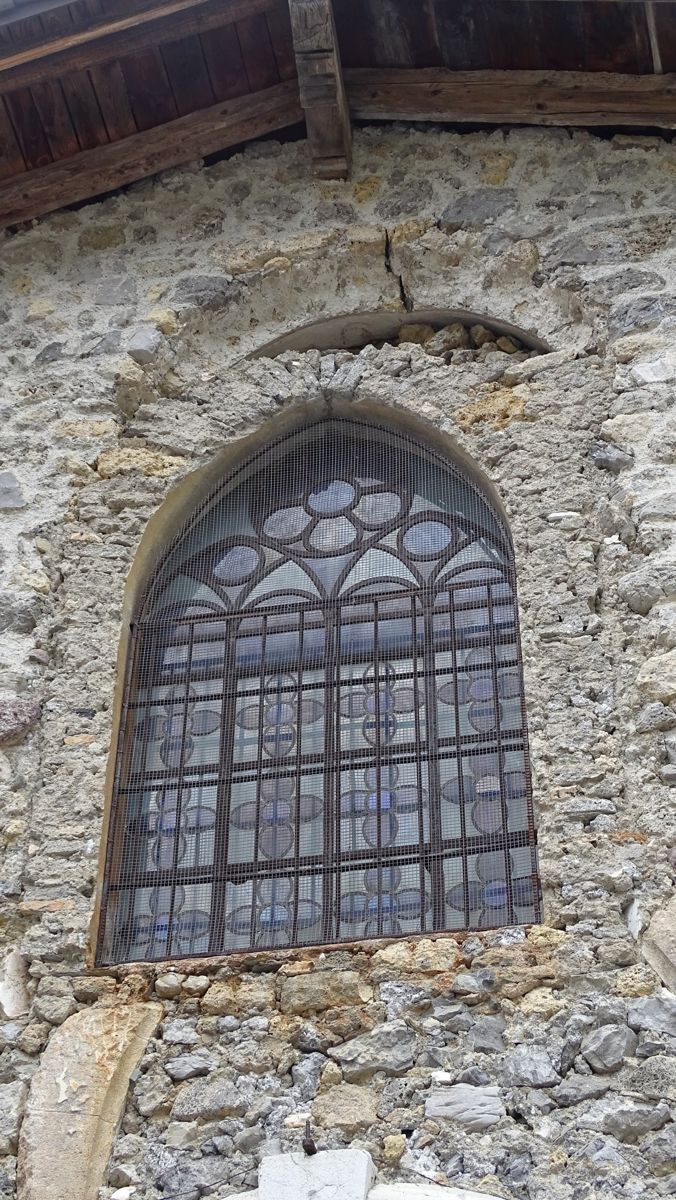
Today the scraping and removal of plaster carried out during restoration on the uphill wall of the old church make it possible to understand the transformations, the significant enlargements and the raising of the building over time, clearly marked by the joints between the different masonry phases. On this wall you can see that from the 14th century the bell tower was set into the body of the nave, and that no fewer than five entrance doorways, of different workmanship and size, have been blocked up, as have five windows and two older diagonal slits. Today, on the north side, the church receives light only from a lunette in the presbytery. Despite the adaptation, enlargement and raising of the church, the canonical east-west orientation has not changed. On the downhill side the ground was levelled with artificial fill, which makes the apse wall look taller.
On the façade, a portal of shaped and worked stone dates from the 17th century, as does the large window, which nonetheless preserves the remains of a rose window blocked up when the building was raised further. This shows that the church floor was once lower: indeed, Saint Charles Borromeo, on his visit of 23 October 1566, tells us that on entering the church "one went down five steps". Also of interest on the façade are the old window openings, especially the slit window, which probably belongs to the original church. In the 15th century the church was raised and the portico was built on the south side. The portico, a feature common to all the old baptismal churches of the upper valley, was originally lower but was later raised, as shown by the side entrance known as the men's door, now blocked and cut by the floor. The portico, which looked onto the cemetery, was the meeting place of the assembly of "free men and neighbours" (that is, of the vicinie, the hamlets), who gathered there to deliberate on the affairs of the commune and of the church, which was run by two syndics and a treasurer elected every two years by the assembly of heads of household.
The church was certainly consecrated on 7 August 1468 by Monsignor Paolo Neapolitano, suffragan bishop of the Cardinal of Milan, Stefano Nardini. The tradition, also handed down through recent inscriptions, that Saint Charles Borromeo reconsecrated the church during his first pastoral visit on the evening of 23 October 1566 is neither certain nor documented. The pastoral visit is commemorated by a fresco, now transferred to the end wall, showing the coat of arms of the saintly cardinal and recording the visit, but saying nothing about a reconsecration. Saint Charles's second pastoral visit took place on 8 July 1582. The resulting report mentions four altars in the church besides the high altar: that of the Madonna, the altar of San Gottardo, the altar in the chapel of San Nicola and that of Sant'Agata. Other pastoral visits were made in Saint Charles's time by his delegates, who had to oversee the implementation of the cardinal's instructions. The description by the episcopal delegate Leonetto Chiavone after the visit of July 1569 is interesting. He tells us that the church has walls mostly decorated with frescoes, that it has four doors, one of which leads into the curate's house, and eight windows with two circular openings. The church was paved and had three bells. The bell-tower door, as today, opened onto the nave, and the roof was supported, again as today, by four arches covered with painted beams and boarding. The roof was covered with "piode", slate slabs. A fine Crucifix was placed on the triumphal arch; it is still on the high altar today. There were two sacristies. Beside the high altar, on the Gospel side, was the chapel of the Madonna, and on the Epistle side the chapel of San Gottardo. Accessed from the presbytery was also a burial chamber, the ossuary, and on the wall above its entrance was painted the figure of Death with a bow in hand, dragging behind her, tied in a line, the victims already fallen.
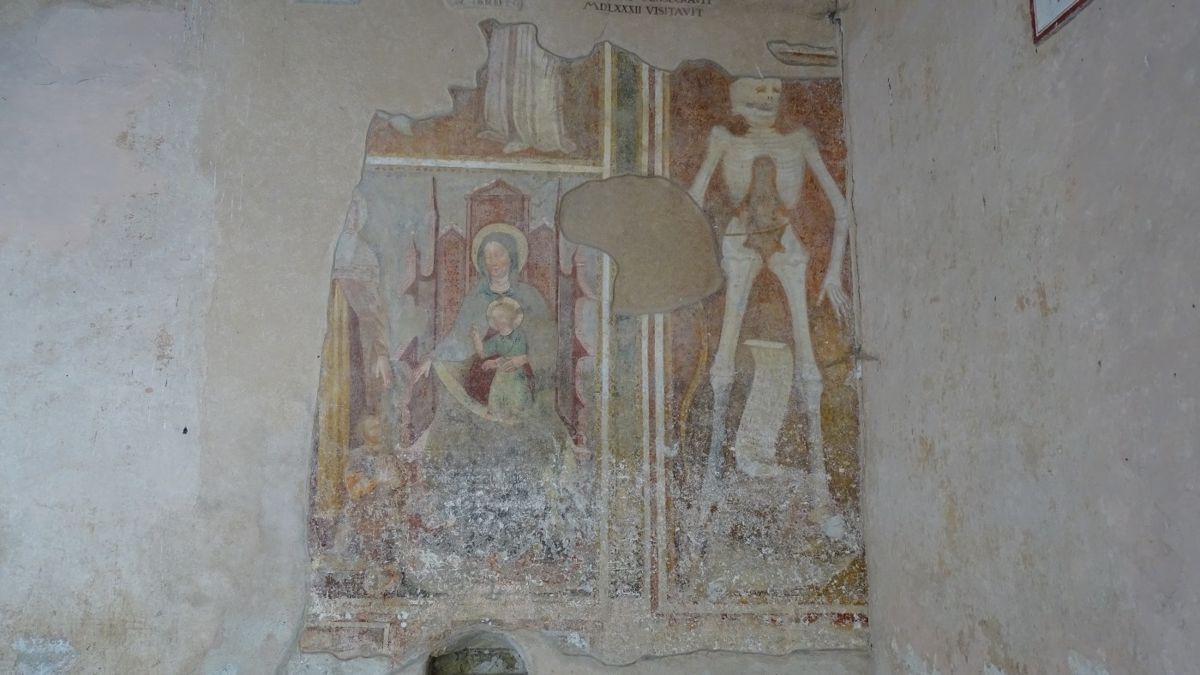
Macabre frescoes can still be seen in the portico, and beneath the altar, with an outside entrance, the semi-underground ossuary chamber still exists. The church lacked a pulpit and a proper setting for the baptismal font. An important event for the church of Santa Brigida was the granting of a special indulgence to its inhabitants. The Bull, signed by Saint Charles and dated 3 December 1575, is kept in the parish house. At the end of the 16th century the Baptistery Chapel was built, entered from the north wall just inside the entrance. During the 20th-century restoration the chapel was demolished, and today the walled-up arch that led into it can be seen from outside. On 24 June 1611 Cardinal Federico Borromeo visited, and among his instructions was the placing in the church of the tomb of the De Pezzijs family, the family of the great painter Giampaolo, known as Cavagna. The Baroque arrangement of the side altars, with faux-marble columns and stucco, dates from the late 17th century, just as in 1653 the triumphal arch and the end arch had been embellished in stucco with statues of Saint Ambrose and Saint Brigid, and stucco statues of Saint Joseph and Saint Anthony of Padua had been placed at the base of the first arch. Unfortunately, with these works the fresco cycles on the vault and walls of the presbytery depicting the story of Saint Brigid were lost. In 1737 a large ossuary chapel with an altar was built outside, at the edge of the cemetery, opposite the portico; mass was allowed to be celebrated there, and the statue of the Virgin of Sorrows was moved there. This structure was demolished in 1925. On 25 June 1754 Cardinal Giuseppe Pozzobonelli made a pastoral visit, having come up the valley to consecrate the churches of Cusio and Ornica; in his report he tells us, among other things, that the church has three altars: that of the Madonna of the Rosary, that of San Gottardo and that of San Carlo. Cardinal Pozzobonelli was the last bishop of Milan to make a pastoral visit to the Valle Averara. On 22 October 1784 Bishop Dolfin of Bergamo, regarding a dispute between the archpriest of Santa Brigida and the parish priest of Averara, reminded the curate of Santa Brigida that the parish had passed under the Diocese of Bergamo. In 1858 the church was given an excellent organ by Deodato Bossi, now in the new parish church. In 1925 the new parish church took the place of the old one, which remained alone as the Sanctuary of the Madonna Addolorata. The curate's house to the north and the ossuary of the old cemetery were demolished. Over the years the summer centre of the San Vincenzo patronage grew, and for years it adopted and brought new life to the old parish church of Santa Brigida.
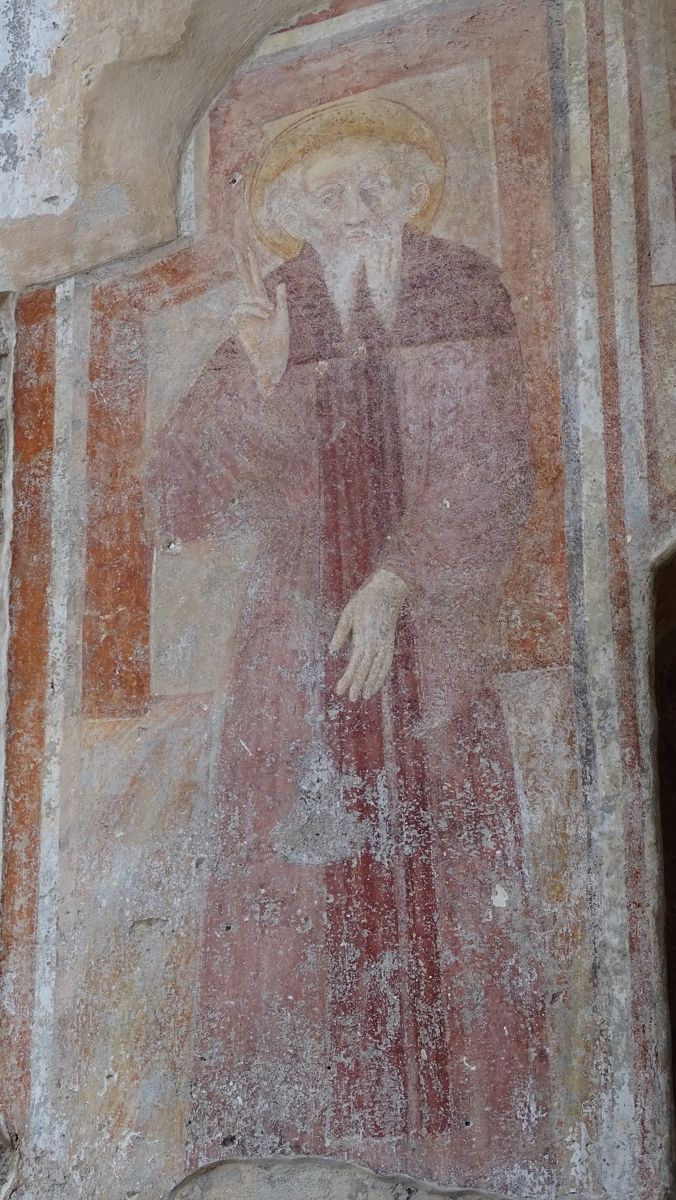
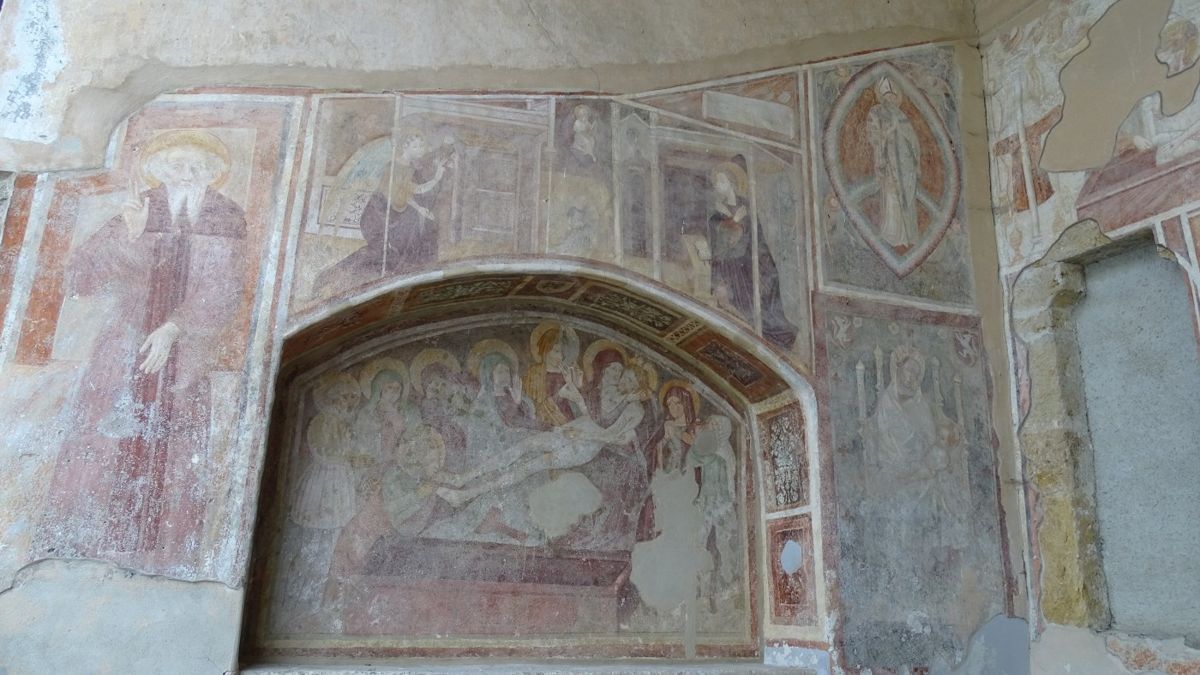
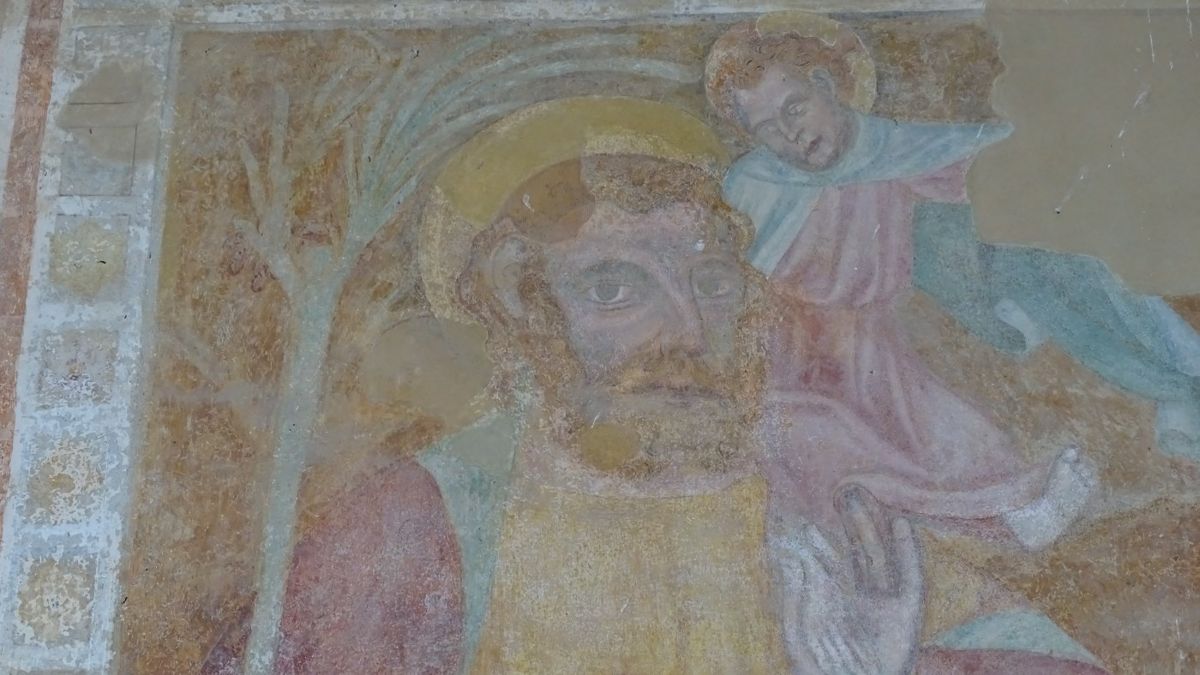
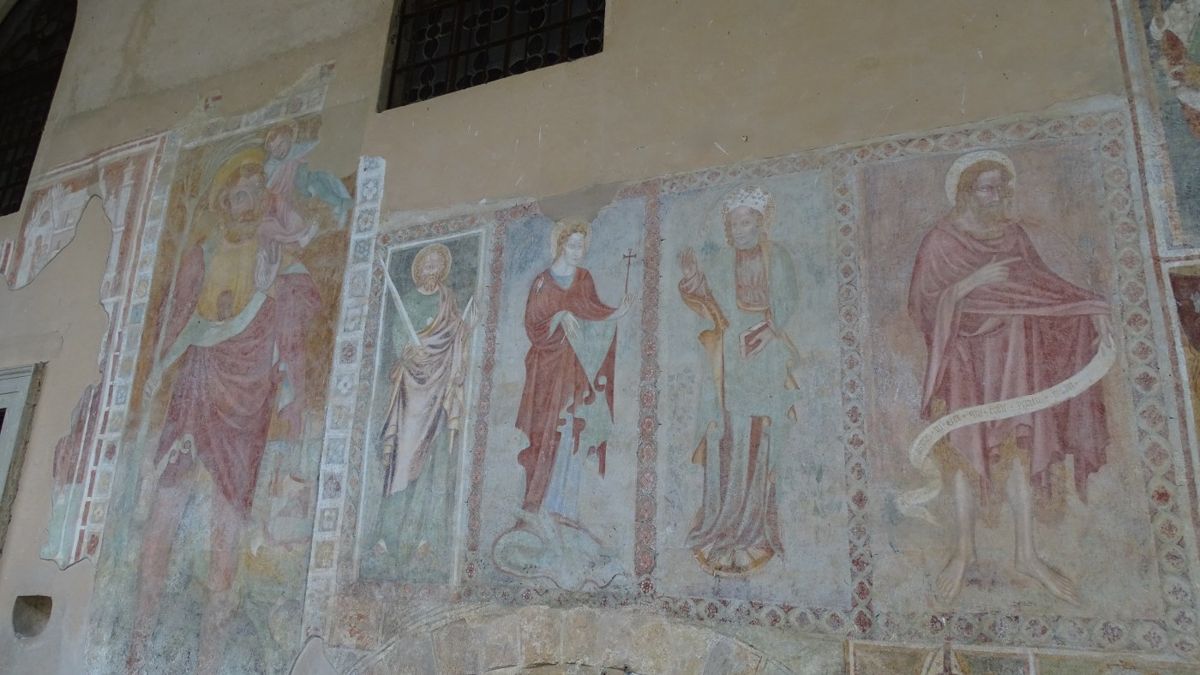
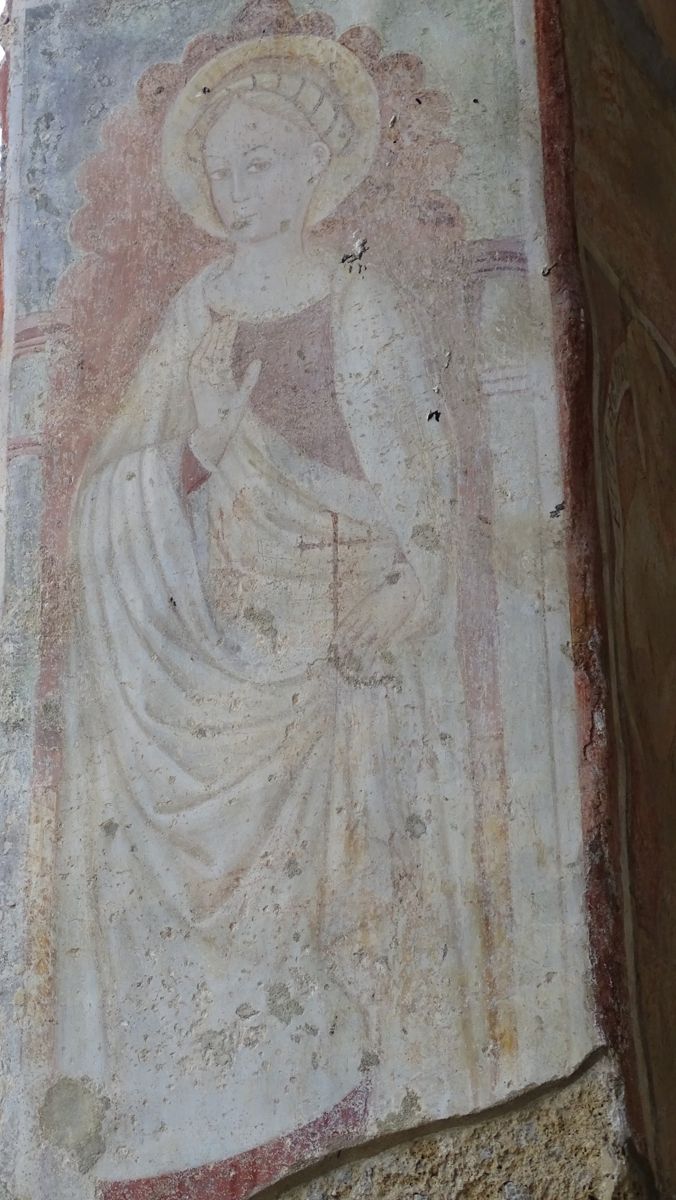
Our first encounter with the church of Santa Brigida takes place under the old portico, where you can read the transformations and architectural additions to the church, and where we are welcomed by important fresco cycles that are only part of the original ones. On the walls, images of Saint Anthony Abbot, Saint Ambrose, the soldier Saint Defendens, a towering Saint Christopher, Saint Paul, Saint Margaret, Saint Catherine and Saint John the Baptist speak of the devotion of our ancestors. There are many Madonnas in Majesty with the Child, and the Annunciation at the end of the portico is very fine and very Florentine. The Deposition in the arcosolium of an old tomb, also at the end of the portico, was transferred from above the entrance to the first ossuary off the presbytery. The three pillars are also frescoed and signed by the artist, the painter Petrus de Asenelis, with the date March 1444. The coat of arms of the Asinelli family of painters is also frescoed above the old men's door, now walled up. The frescoes were devotional votive offerings made by the many artists of the Valle Averara and especially of Santa Brigida, such as the Baschenis, the Guerinoni, the Asinelli, the Scanardi, the Scipioni and the Pezziis.
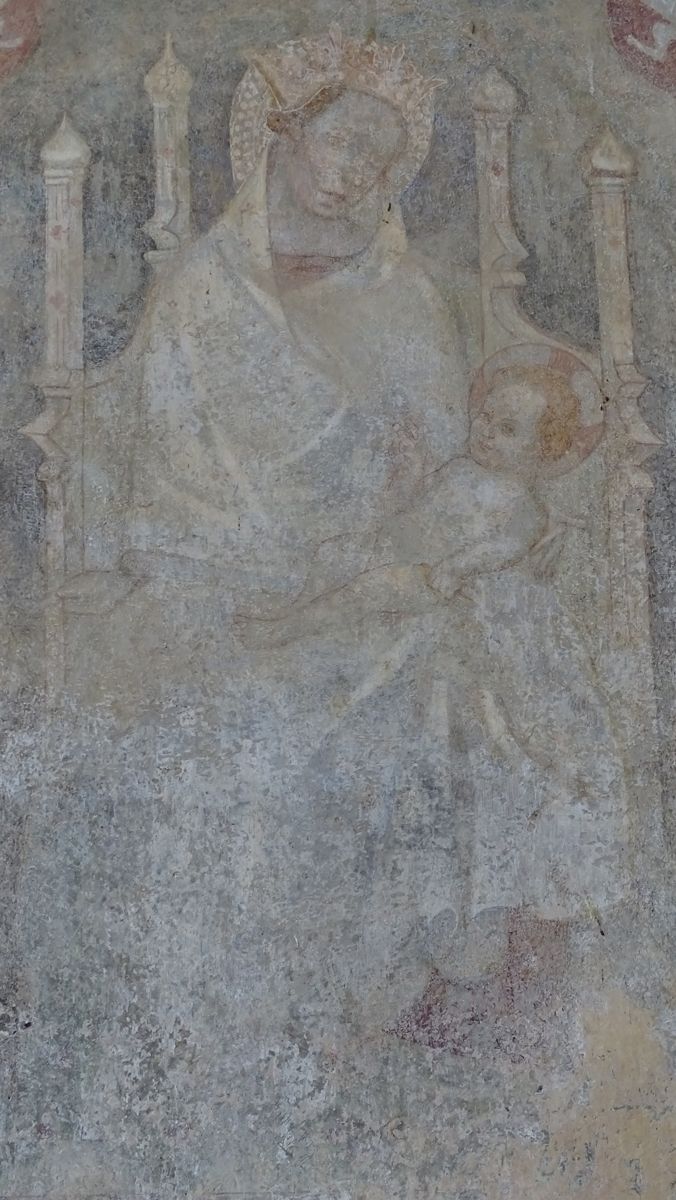
At the end of the portico, the fresco of the Virgin and Child and the allegorical figure of Death are the remains of an old outdoor chapel of the Madonna and of that cycle of macabre frescoes leading to the ossuary beneath the presbytery. Entering the church, we look at the presbytery, reached by three steps of black marble from the local Valle dei Gatti and separated from the nave by a balustrade, also of black marble, decorated with floral inlays. The flat-ended apse was frescoed with a large Crucifixion scene, of which part of the two thieves crucified beside Jesus survives, while Jesus himself has disappeared; at the foot of the cross, part of the group of mourners remains. The work can be attributed to a good painter of the late 15th century. Below and beside this large fresco are two frescoed panels: the one on the right shows the Madonna between Saint Roch and Saint Sebastian, dated 5 April 1483, with an invocation against all pestilence, and the one on the left shows Christ in the tomb flanked by Saint Lawrence and Saint Onuphrius, dated 1478. The prayer of the wounds of Jesus written in Gothic letters on the tomb is a text found in other frescoes in the valley. These two panels show a late Gothic taste and belonged to the first fresco cycle covered by the Crucifixion. In the lunette of the apse, at the beginning of the 20th century, a painting of the Deposition of Christ was inserted, the work of the painter Domenighini, first director of the Fantoni art school in Bergamo. Along the walls there were continuous fresco cycles, now reduced to a few fragments, such as the image of the Virgin on the recessed wall of the bell tower, that of Saint Sebastian in the chapel once dedicated to Sant'Agata, now to the Madonna, and that of Saint Anthony Abbot on the pilaster near the presbytery, where unfortunately the entire cycle of the life of Saint Brigid has been lost. The chapel of San Nicola da Tolentino in the second bay on the south side is very unusual and entirely frescoed. The frescoes show two layers of painting. The older layer, at the back of the chapel, is the sequence of eight figures depicting Christ and the Apostles, together with the figures of Saint Sebastian and Saint Catherine at the springing of the chapel's arch. New frescoes were painted over these, narrating the life of Saint Nicholas in panels. At the top of the inner arch is Christ Pantocrator in a mandorla and nimbus, surrounded by the symbols of the four evangelists, and on the first intrados of the arch, on either side, the four Doctors of the Church: Saint Ambrose, Saint Jerome, Saint Gregory and Saint Augustine. At the top of the wall is the Crucifixion scene, and at the sides the first panels with scenes from the saint's life, also explained in the vernacular in the frame. The work is generally attributed to Angelo Baschenis, who signed the frescoes in the church of Ornica in 1485.
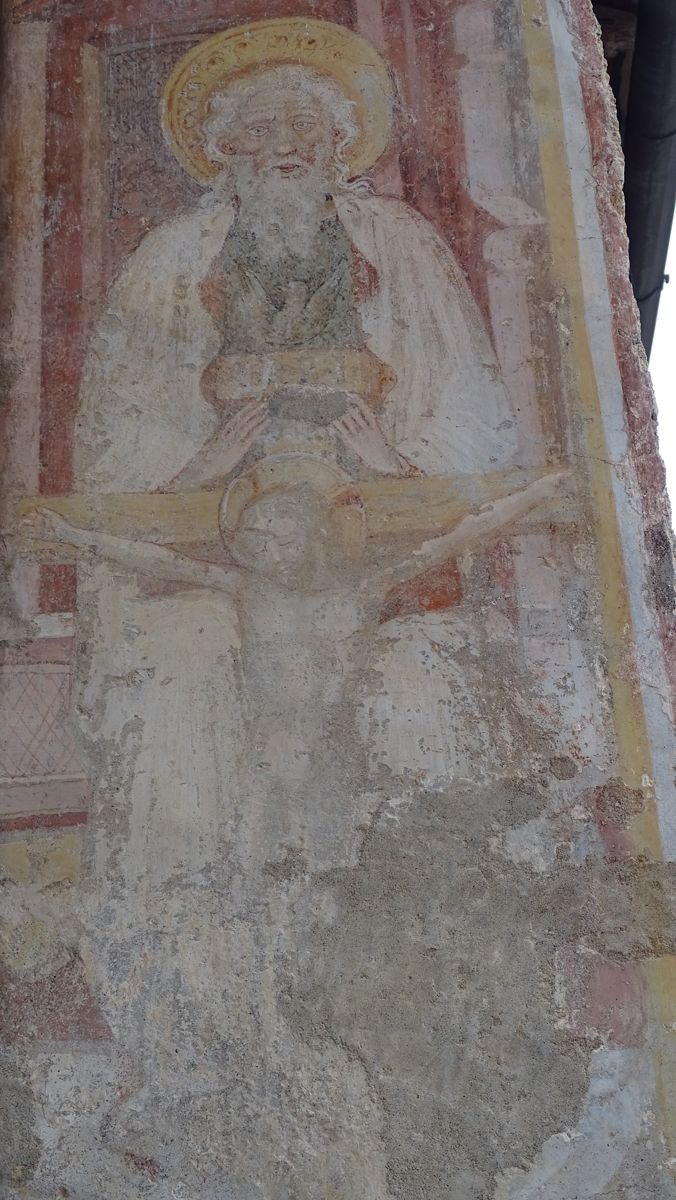
Among the other works, the fine 16th-century Crucifix on the high altar, the work of a very able local sculptor, deserves attention. At the side altars, on the right, the painting of the Beheading of Saint John the Baptist is a truly excellent work, unanimously attributed to Carlo Ceresa (1609-1679). Also very beautiful is the small 16th-century painting of the Risen Christ on the door of the tabernacle. On the wall, the canvas depicting the martyrdom of Saint Agatha is a good late 16th-century work. The left altar is dominated by a mannerist 17th-century altarpiece depicting Saint Anthony of Padua. On the north wall, the carved and gilded wooden ancona is a good 18th-century work by a local workshop, from the oratory of San Lorenzo at Carale. The statue of the Madonna Addolorata placed in this ancona was acquired in 1935. On the wall of the last bay on the north side, the fine painting of the Madonna in Glory with the Child, with Saint Charles and Saint John the Baptist at her feet and the coat of arms of the donor Goglio, is clearly the work of Carlo Ceresa's workshop, even if the hand of his pupils is a little too evident. Finally, on the end wall we see the coat of arms of Saint Charles, a transferred fresco painted on the occasion of the solemnly commemorated visit of October 1566.