The Danse Macabre
The danse macabre (dance of death) is a late medieval iconographic theme depicting a dance between living people and skeletons.
The skeletons personify death, while the living are usually dressed to represent the various ranks of society of the time, from the humblest, such as peasants and craftsmen, to the most powerful, such as the emperor, the pope, princes and prelates.
The subject serves as a memento mori ("remember that you must die") and, compared with the apocalyptic subjects more common in the early Middle Ages, such as depictions of the Last Judgement, it expresses a more individual vision of death and sometimes even a certain irony towards the social hierarchies of the time. It is worth noting that over time the figure of Death as the agent of divine will disappears, leaving iconographically only the corpses, symbols of the disturbing call of the afterlife, and secularising the very idea of death.
The spread of the theme, together with a certain relish in depicting skeletons and the dead, has been linked to the Great Plague of 1348, which raged throughout Europe and made death a familiar phenomenon in every European country. Alberto Tenenti stresses that the "sense of pity" for one's own fate and the tragic irony typical of these works were fundamental steps in freeing humankind from the Christian ideal of death.
Paintings on this theme can be seen in various places in Europe: Italy, Croatia (Hrastovlje, Beram), France, Germany, Switzerland, Estonia and elsewhere.
One of the oldest known depictions of the "Danse macabre" is undoubtedly the one painted in Paris in 1424 along one of the walls of the old Cemetery of the Holy Innocents. From here the name was consecrated in its Latin form, Chorea macabæorum. This mural was destroyed in 1669, but it was soon copied on the walls of other European cemeteries, such as the one near St Paul's Cathedral in London.
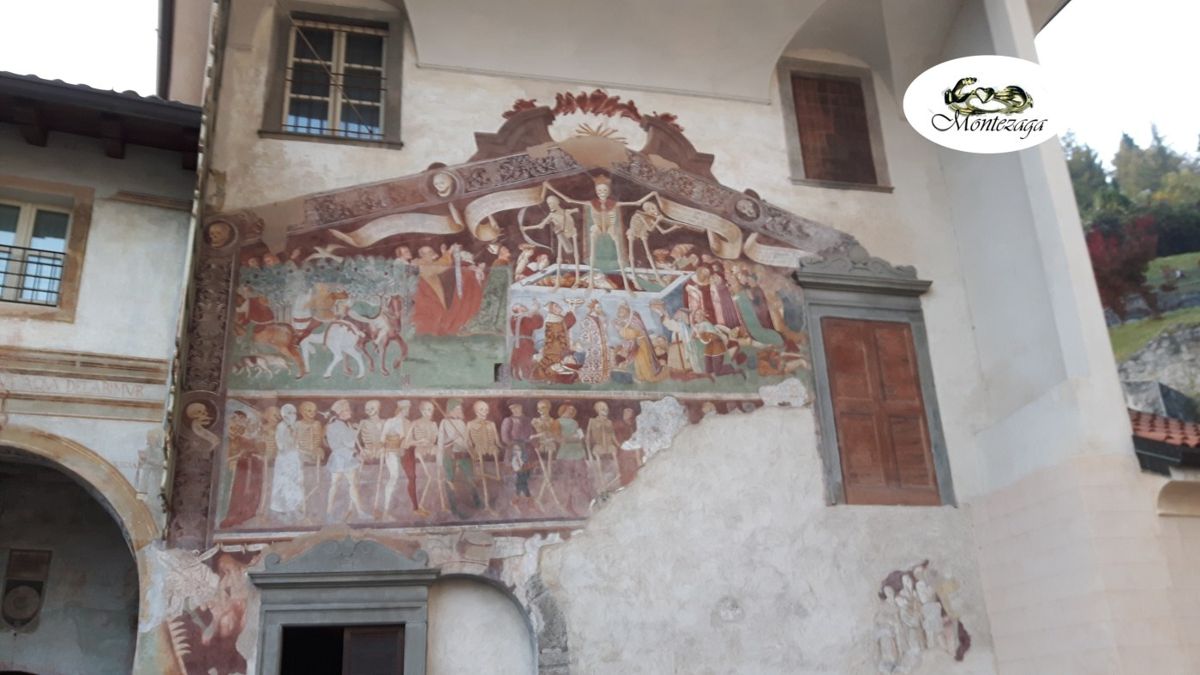
Besides an example of the danse macabre, the Oratory of the Disciplini in Clusone displays on its outer façade, facing the Basilica of Santa Maria Assunta, two other macabre scenes: the Triumph of Death and the Encounter of the Three Living and the Three Dead.
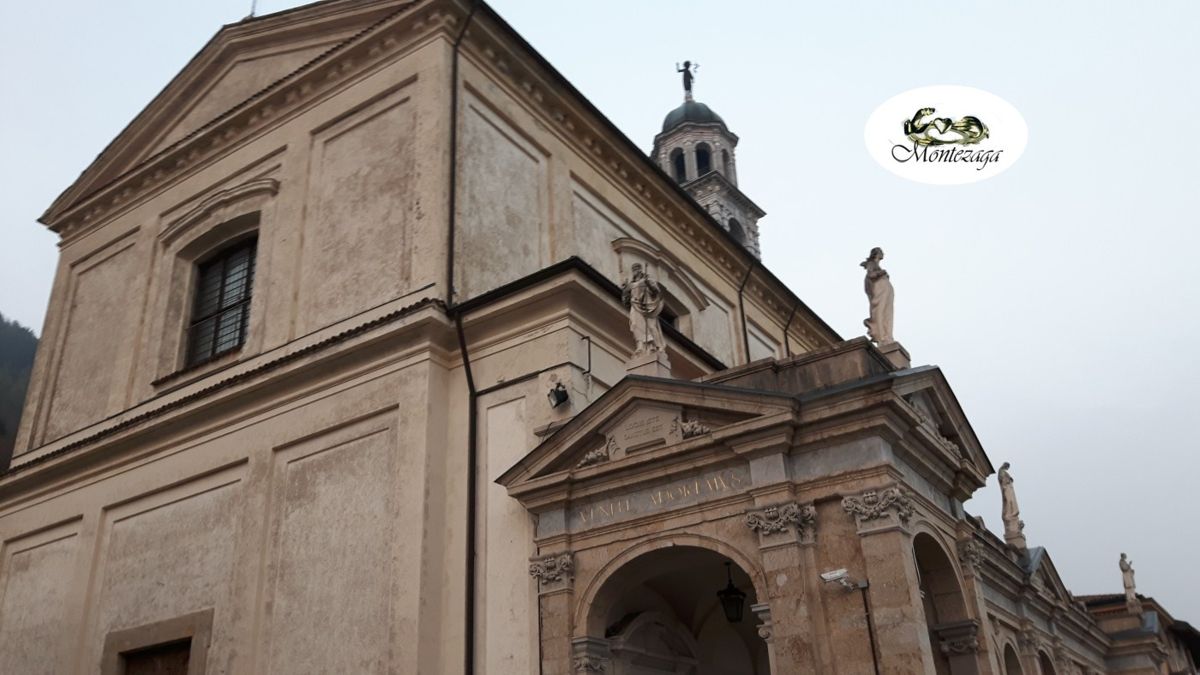
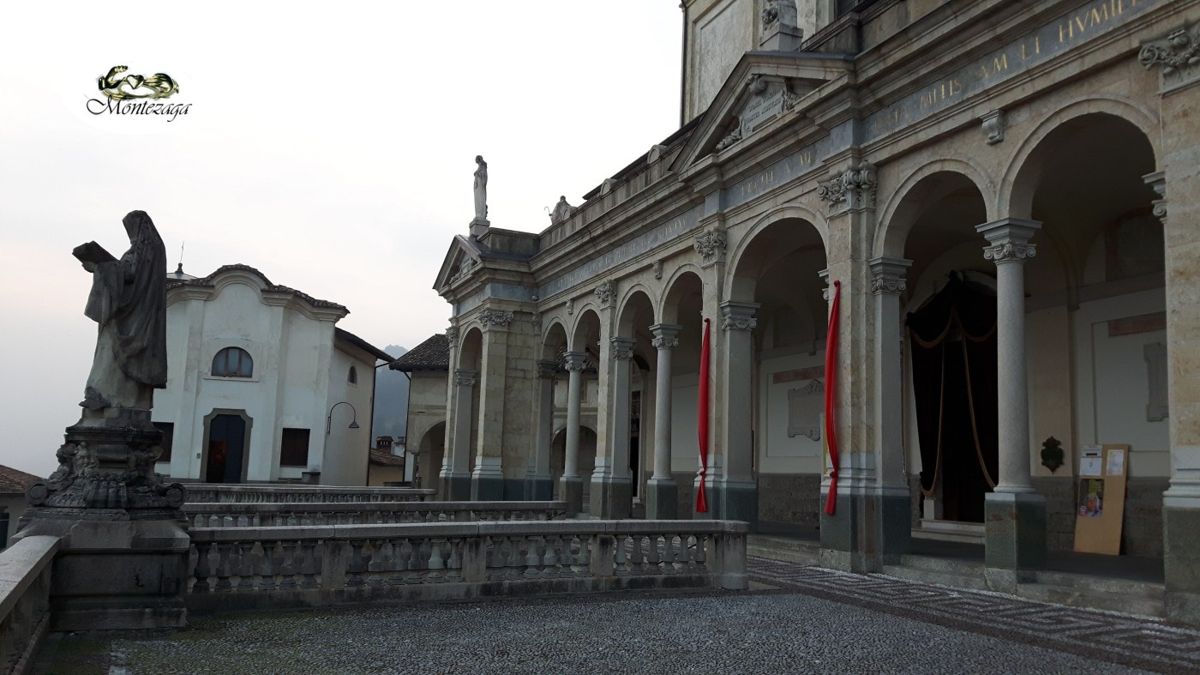
The Oratory of the Disciplini in Clusone, in the Val Seriana in the province of Bergamo, is a building of medieval origin commissioned by the confraternity of the Disciplini (flagellants) as the seat of their order. The building, simple in structure, has a fresco cycle of great value, dated 1484–1485 according to the congregation's registers, painted by the Clusone artist Giacomo Borlone de Buschis.
Outside, on the façade, the macabre paintings are divided into five parts, in several registers.
The Triumph of Death
At the top centre is the Triumph of Death: Death is depicted as a great queen who subjugates everyone; she is shown as a triumphant skeleton wrapped in a cloak, with a crown on her head. She unfurls scrolls on which is written: Gionto (e sonto) per nome chiamata morte/ferisco a chi tocherà la sorte;/ no è homo chosì forte/che da mi no po' a schanmoare [I have come (and I am) called by the name of Death / I strike whomever fate befalls; / there is no man so strong / that he can escape from me] and Gionto la morte piena de equaleza/sole voi ve volio e non vostra richeza/ e digna sonto da portar corona/perché signorezi ognia persona [I am Death, full of equality / I want only you and not your riches / and I am worthy to wear a crown / because I rule over every person]. The scroll held by Death continues with two more inscriptions: Ognia omo more e questo mondo lassa/chi ofende a Dio amaramente pasa 1485 [Every man dies and leaves this world / whoever offends God passes bitterly, 1485] and Chi è fundato in la iustitia e (bene)/ e lo alto Dio non discha(ro tiene)/la morte a lui non ne vi(en con dolore)/ poy che in vita (lo mena assai meliore) [Whoever is founded in justice and (goodness) / and does not displease God on high / to him death does not come with pain / for it leads him to a far better life]. The eloquence of these verses saves no one: Death in her guise as queen accepts no gifts and has no interest in them; the only wealth she knows is people's lives. She saves no one and chooses at random, letting fate decide whom to strike, but she does not inflict the same suffering on all: everything depends on the honesty of each person's life. These scrolls contain part of a lauda sung by the confraternity of the Disciplini at their gatherings; the idea of the meditatio mortis had strongly marked the 15th century, a period of great change.
Below the scrolls are the powerful of the earth: a doge, a bishop and a knight, while a king questions a Jew to find out how to bribe Death. All implore her, offering her wealth, offering her a kingdom, but nothing can overturn or delay, in its justice that makes no distinctions, the only true and certain thing in life: death itself. At Death's feet, in a marble tomb, lie the bodies of the Pope and the Emperor, surrounded by snakes, toads and scorpions, emblems of pride and sudden death. This symbolises her power, which spares no one.
The depiction of the doge confirms the rule of the Venetian Republic, and he has been identified as Mocenigo, the doge who died of plague, while the Pope has been identified as Sixtus IV, who died the year before; the other figures have also been identified as Philibert, Duke of Savoy, Count Pietro dal Verme and Costanzo Sforza, Duke of Pesaro. In any case, the great Queen strikes mercilessly, helped by other skeletons. These assistants at her side have the task of killing. The one to the right of Death holds a kind of arquebus and mercilessly strikes a group of pleading people above the scroll stating that death strikes painfully only those who offend God, while it leads those who practise justice to a better life; to her left a skeleton strikes with three darts, like the three arrows that Greco-Roman tradition assigns to Saturn, the god who governed past, present and future.
The Encounter of the Three Living and the Three Dead
On the left, in the same register, set within the Triumph of Death, is the Encounter of the Three Living and the Three Dead. It shows three knights who, in various attitudes, have met Death during a falconry hunt.
It is the arrow shot by the skeleton on the Triumph of Death that strikes the hunter, while some people hidden in the green of a wood watch and comment on what is happening in the scene.
The Danse Macabre
In the middle register is the danse macabre, with an inscription separating the two levels: O ti che serve a Dio del bon core non havire pagura a questo ballo venire ma allegramente vene e non temire poj chi nasce elli convene morire [O you who serve God with a good heart, have no fear of coming to this dance, but come joyfully and do not be afraid, since whoever is born must die]. A rhythmic procession of figures crosses the scene from left to right, depicting the egalitarian value of death. Each living person, with a frightened, desperate expression, meets his or her own corpse, which, smiling, confounds their fear. These figures, of lower rank than those in the register above, have no gifts to offer but share the same apprehension; yet they are accompanied, representing the justice of death, which, though it cannot change social conditions on this earth, accompanies everyone equally in death.
Starting from the left, the first figure we meet is a woman holding a mirror that reflects the hallway crowded with skeletons behind her; this echoes the depiction in Basel, where the same figure bears an inscription which, translated, reads: "my features show life and the mirror reflects death".
The second figure is a hooded Disciplino holding the scourge with which he whips his right shoulder; he represents those who commissioned the fresco, and he is the only one shown between two skeletons.
The third figure is a peasant, a figure found in many other depictions; he wears worn hose with holes at the knees and carries a staff over his shoulder from which a bag hangs.
The fourth is an innkeeper, recognisable by the vessel he holds, typical of the 16th century.
The fifth figure is an officer of justice, a podestà with judicial functions, which was indeed his role under the Venetian Republic from 1427; he holds the staff of command and wears a pair of German-style leather boots.
The sixth is the only one who looks out of the fresco, and he is held firmly by the skeleton. Well dressed, with his right hand thrust into a purse tied at his waist, he is identified as a merchant or usurer, a figure depicted in most danses macabres.
The seventh figure is a young man with a quill pen in his fair hair, holding a scroll; he is identified as a student or a young man of letters.
As for the eighth and last figure, well dressed, it is difficult to identify his profession, as no trace remains of any attribute that would make him recognisable.
All these figures have strong links with the German and French danses macabres. In Basel, where there is a large depiction, the Bergamo bishop Francesco Aregazzi was present; he was a friend of Saint Bernardino and very close to the Disciplini who commissioned the Clusone fresco.
The Last Judgement
In the lower register, now badly damaged, is the last depiction of the Four Last Things. On the left, the gaping mouth of Lucifer receives the souls, depicted as naked female bodies, and burns them in fire: this represents hell. On the right, a group of praying Disciplini, hooded and kneeling in prayer, indicates that this is the only way to paradise. This must have been the indication of the path to follow: the two opposites, the Vices and the Virtues.
Bibliography
- Giuseppe Vallardi, IV p. 8, in Trionfo e Danza della Morte, o Danza Macabra a Clusone, Bergamo, 1859.
- Astorre Pellegrini, Nuove illustrazioni sull’affresco del Trionfo e Danza della morte di Clusone, 1978.
- Domenico Giudici, Il Trionfo della Morte e la Danza Macabra: grandi affreschi dipinti in Clusone nel 1485, Clusone, 1903.
- Tullia Franzi, Luigi Angelini, La Danza Macabra di Clusone, Florence, 1950.
- Arsenio Frugoni, I temi della morte nell’affresco della chiesa dei Disciplini a Clusone, 69 Tip del Senato, Rome, Bollettino Istituto Storico Italiano per il Medio Evo e Archivio Muratoriano, 1957.
- Guido Bonandrini, ed. Turismo pro Clusone and Biblioteca civica centro culturale, Il trionfo della Morte e la Danza Macabra: Clusone 1485-1985, Ferrari Editrice, 1985.
- 1994-1997, Il Trionfo della Morte e le Danze Macabre. Proceedings of the 6th International Conference, Clusone.
- 1998, Ognia omo more. Immagini macabre nella cultura bergamasca dal XV al XX secolo, Antonio Previtali, Mino Scandella, Matteo Rabaglio, Giosuè Bonetti, preface by Franco Cardini, Ferrari editrice.
- Giuseppe Bonetti and Matteo Rabaglio, Danze macabre e riti funebri degli altri, Milan (Castello Sforzesco, Sala della Balla), 1999, proceedings of the study day.
- Alberto Tenenti, Humana Fragilitas. I temi della morte in Europa tra Duecento e Settecento, Clusone, Circolo Culturale Baradello- Ferrari editrice, 2000.
- La signora del mondo. Proceedings of the international conference on the Danse Macabre and the Triumph of Death, Clusone, 2003.
- Mauro Zanchi, Il theatrum Mortis nel nome della vita eterna, Ferrari Editrice