The Triple Enclosure
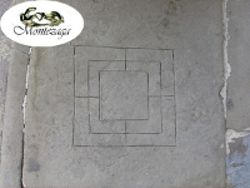 Triple enclosure
The origin of the Triple Enclosure symbol is lost in the mists of time, as it was already present among prehistoric and megalithic civilizations. One example of its circular form from the Bronze Age, probably of Celtic origin, is the engraving on a pendant kept at the Archaeological Museum of Bergamo, while a square version carved on a megalithic block can be found in the town of Alatri (FR). Its meaning remains a mystery to this day. Various hypotheses have been put forward: a depiction of the Celts' Druidic ring of walls; a schematic representation of the walls of the Temple of Solomon, and hence a possible link with the Templar order; a depiction of the Heavenly Jerusalem with its twelve gates; a symbol marking places with particular telluric-magnetic characteristics; a diagram of the three degrees of esoteric-Masonic initiation; a depiction of the capital of Atlantis; the squaring of the circle; and others besides. As you can see, the hypotheses are as fanciful as they are varied. As far as we know, each is equally valid, and therefore none is certain. One thing we feel able to state, after many years of research in the monasteries and churches that belonged to the Benedictine order in Italy, is that this symbol is often found in these places in the most varied positions. We have found triple enclosures carved on cloister walls (Piona Abbey, Lecco), on porch walls (Abbey of San Colombano in Bobbio, Piacenza), on outdoor stone benches (Church of the Madonna delle Grazie in Cocullo, L'Aquila), near entrance portals (Abbey of San Clemente a Casauria, Pescara) and on the outer walls of churches, even high above the ground (Church of San Tommaso in Caramanico Terme, Pescara). We should also point out that we have come across triple enclosures traced in unusual places, such as the steps of an inner courtyard at the Celestinian Hermitage of the Madonna dell'Altare in the province of Chieti, heavily worn because of its position in a busy passageway, and on the stone threshold of an old palazzo in Palena (CH). Obviously we cannot tell you what the exact connection is between these places and the triple enclosure symbol. We simply report its use by Benedictine monks for a reason that is currently unknown, and note the presence of other symbols belonging to the Templar order, such as crosses pattée, depictions of King Solomon and flowers of life, often found together with the triple enclosure.
Bibliography:
- I luoghi delle Triplici Cinte in Italia, Marisa Uberti - Giulio Coluzzi, Eremon Edizioni
- L'altro Impero Cristiano, Eduardo R. Callaey, iTrofei