Depictions of the Madonna and Child: iconographic evolution, theological meaning and cultural significance
Introduction
For centuries the depiction of the Madonna and Child has been a focal point not only of Christian devotion but also of aesthetic and theological reflection in European art. More than any other subject, it bears witness to the dynamic relationship between religious imagination, cultural change and artistic experimentation. From the dogmatic rigour of Byzantine icons to Renaissance tenderness, from Baroque theatricality to twentieth-century provocation, this image has constantly renewed itself while retaining its symbolic power.
1. Early Christian origins and figurative syncretism
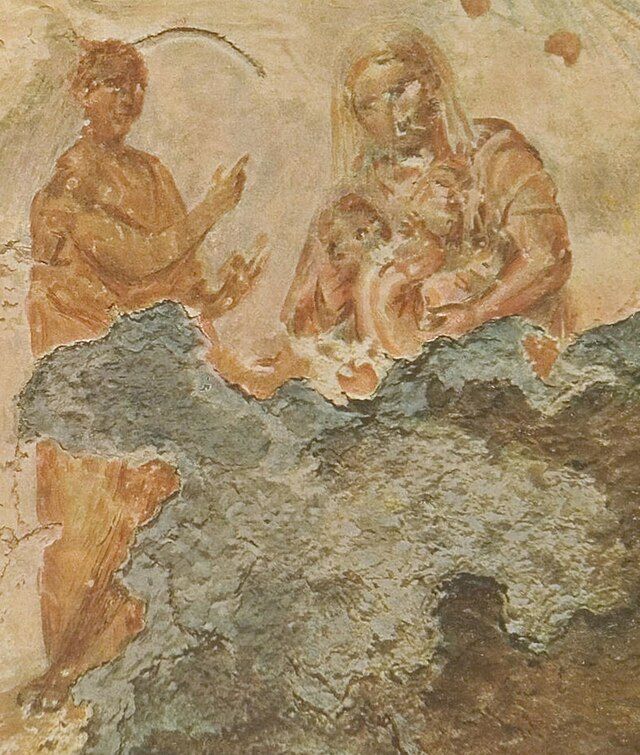
The oldest depictions of the Madonna and Child date back to the 3rd century AD, in a context still deeply bound to the figurative culture of the late antique Roman world. These images do not yet occupy an autonomous iconographic space; rather, they form part of narrative cycles linked to the life of Christ or of Mary, often in the Roman catacombs.
The most significant aspect of these early examples lies not so much in their style as in their symbolic value: the Virgin is represented as mater ecclesiae, a figure of the Church itself, and the Child as a symbol of universal Salvation. Stylistically, the Madonna is shown frontally, in a hieratic but simple pose, seated with the Child on her knees, following a model that recalls the Egyptian statue of Isis with Horus, an element suggesting the reuse of pre-Christian iconographic archetypes to convey the message of the new faith.
Madonna and Child, fresco in the Catacomb of Priscilla, Rome, 3rd century.
2. The Madonna Theotokos: Byzantine hieraticism
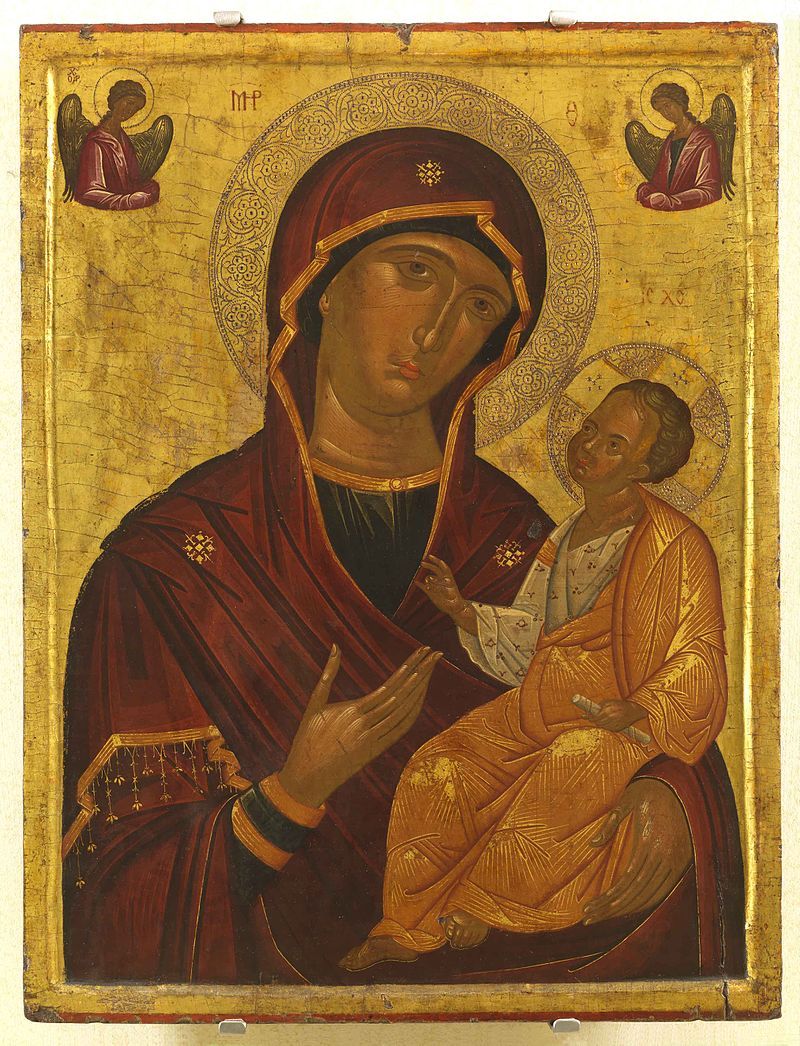
The Council of Ephesus (431) marks a watershed in the iconographic history of the Madonna, confirming the legitimacy of her veneration as Theotokos (God-bearer). Byzantine art codified this image within strict canons, in which dogma prevails over emotion or naturalism.
In icons of the Byzantine tradition the Madonna assumes a solemn, regal bearing: often seated on a throne, surrounded by angels or saints, she holds the Child in her arms as a sovereign presents a successor. The use of gold backgrounds, the absence of perspectival depth and the austere expressions of the faces emphasise the transcendence of the subject and its liturgical function. Two iconographic variants became established in this period: the Hodegetria, in which Mary points to Jesus as the "way" to salvation, and the Eleousa, in which mother and son show a rare moment of affection, albeit expressed with the ritual composure typical of Byzantine painting.
Virgin Hodegetria, 16th century, oil on panel, Cretan school
3. The Gothic and humanised tenderness
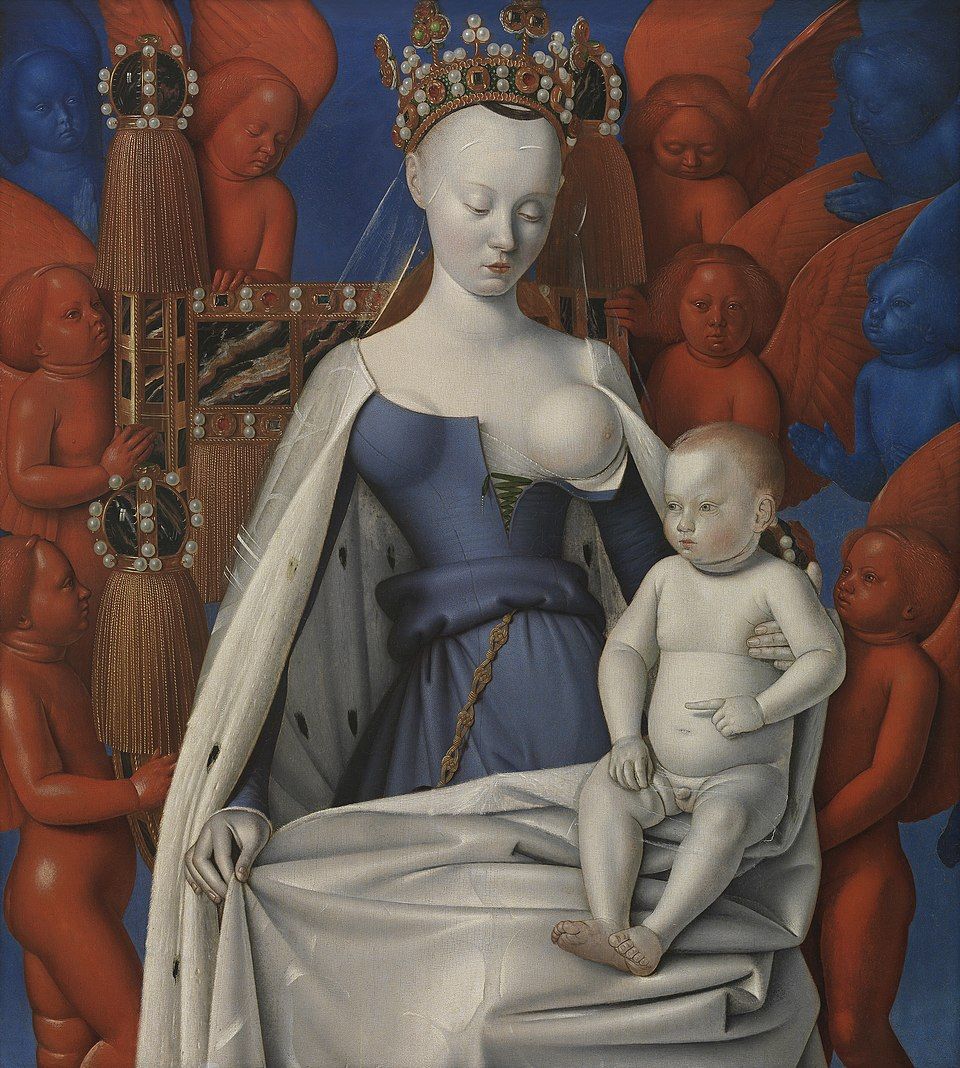
The advent of the Gothic (12th–14th centuries) brought a gradual softening of Byzantine hieraticism. In an age of intensifying personal piety and Marian devotion, art began to represent the Madonna not only as Queen of Heaven but also as an affectionate, caring mother.
In many Gothic sculptures and paintings the Madonna appears in more natural, maternal poses, caressing the Child, offering him a fruit or supporting him as he takes his first steps. The iconography becomes more narrative and realistic, and the mother's gesture no longer solemnly points to the son as the "way" but focuses on the personal relationship between the two, arousing empathy in the viewer. This shift reflects a broader transformation of medieval spirituality, increasingly marked by affective devotion and emotional identification with the figure of the Virgin.
Jean Fouquet, Madonna and Child (Melun Diptych), c. 1452
4. The Renaissance: between humanism and formal perfection
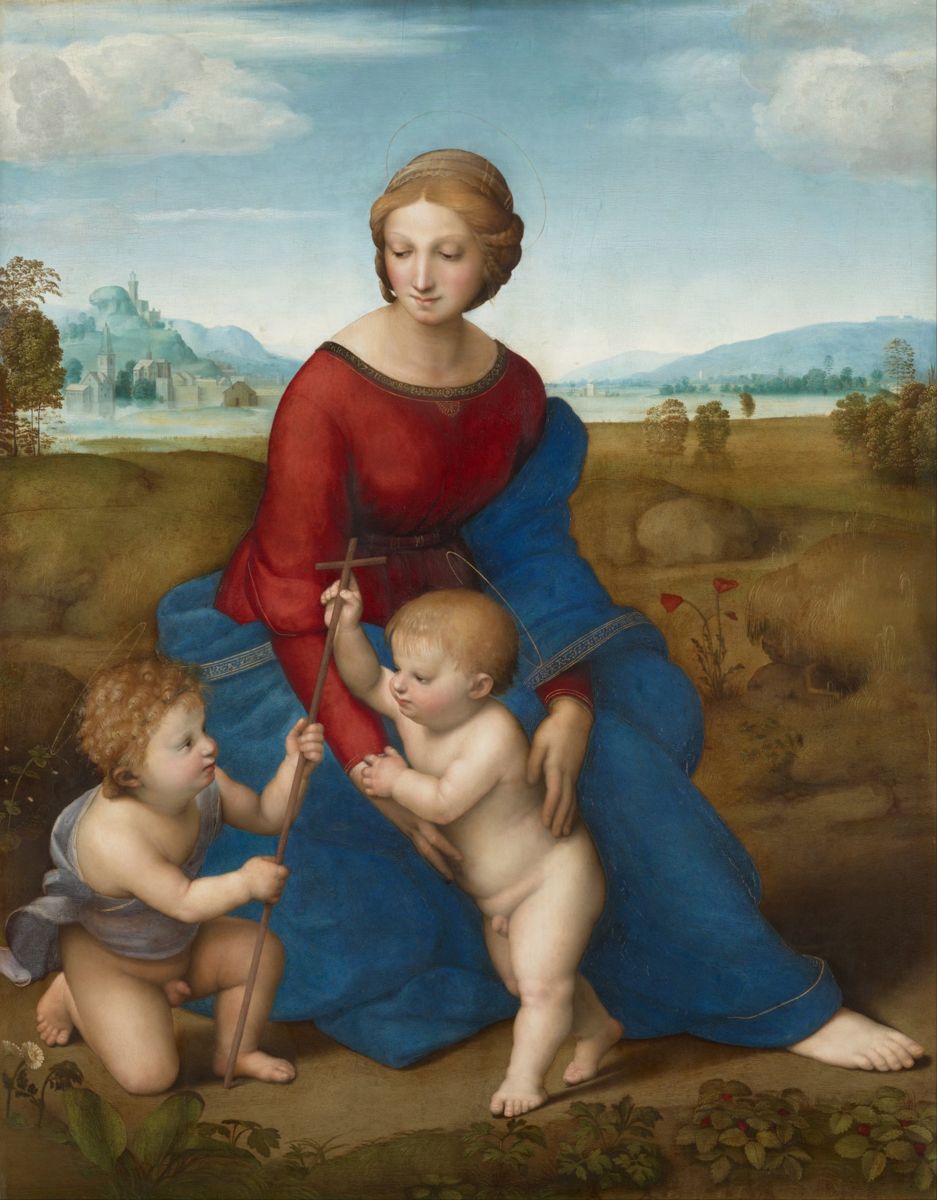
The Renaissance marks a radical turning point in the history of the Madonna and Child. The rediscovery of classical models and the interest in anatomy, light and natural space led to a new rendering, deeply humanised and harmonious. Mary and Jesus are no longer only figures of worship but also models of ideal beauty.
The sacred scene is now set in realistic landscapes, and the figures have gentle expressions, well-proportioned bodies and affectionate poses. Raphael, with works such as the Madonna of the Meadow and the Sistine Madonna, struck a perfect balance between human tenderness and spiritual sublimity, giving his figures a composed grace that is nonetheless full of feeling.
The Renaissance, especially in Italy, interprets motherhood not only as a biological function but as an expression of cosmic harmony and divine order, placing Mary within the panorama of civic and moral virtues that make up the humanist canon.
Raphael, Madonna of the Meadow, 1506
5. The Baroque: theatricality and pathos
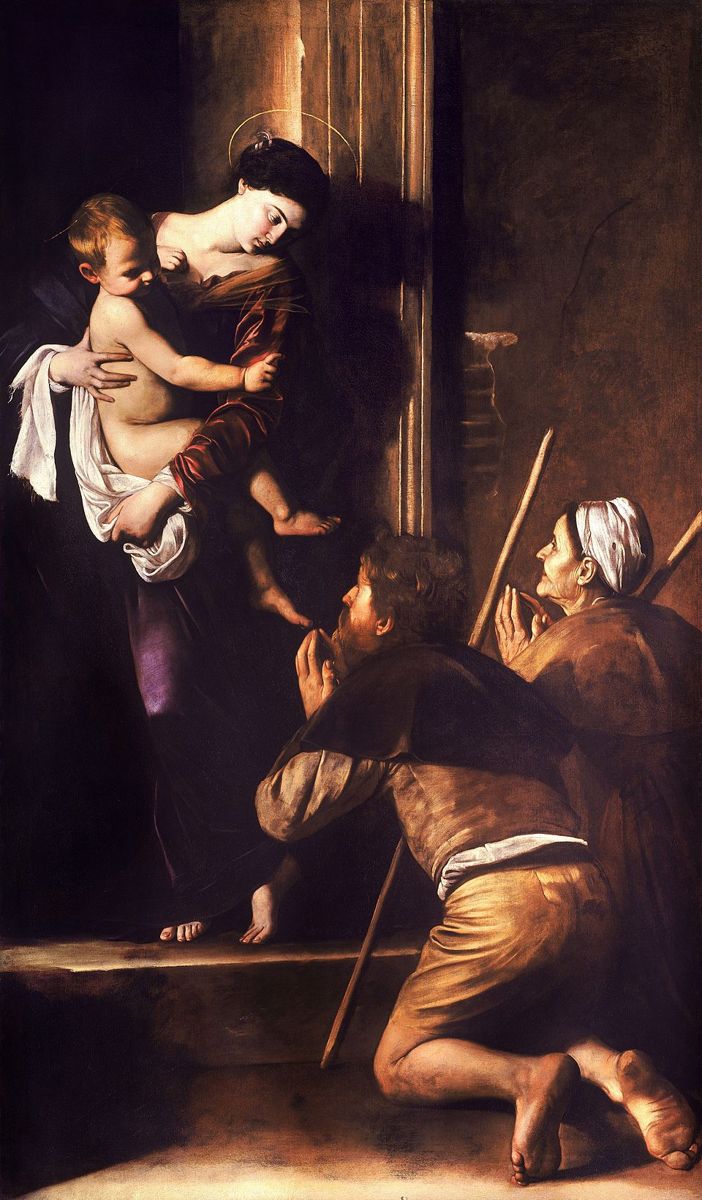
In the 17th century, under the influence of the Counter-Reformation, sacred art became a visual instrument of emotional communication and religious persuasion. Images of the Madonna and Child became charged with drama: compositions are dominated by raking light and theatrical chiaroscuro, and the figures display a more pronounced physicality and moving expressiveness.
With the Madonna of the Pilgrims, Caravaggio broke with the idealised tradition, depicting the Virgin as a young woman of the people, barefoot, with the Child in her arms, in a humble and realistic setting. This new naturalism gives the scene an extraordinary emotional tension, placing the piety and identification of the faithful at its centre.
The Baroque thus accentuates the sensory and spectacular dimension of sacred imagery, linking the figure of Mary to everyday experience and human compassion, in keeping with the pastoral aims of the time.
Caravaggio, Madonna of the Pilgrims, 1604-1606
6. Rococo: grace, lightness and decoration
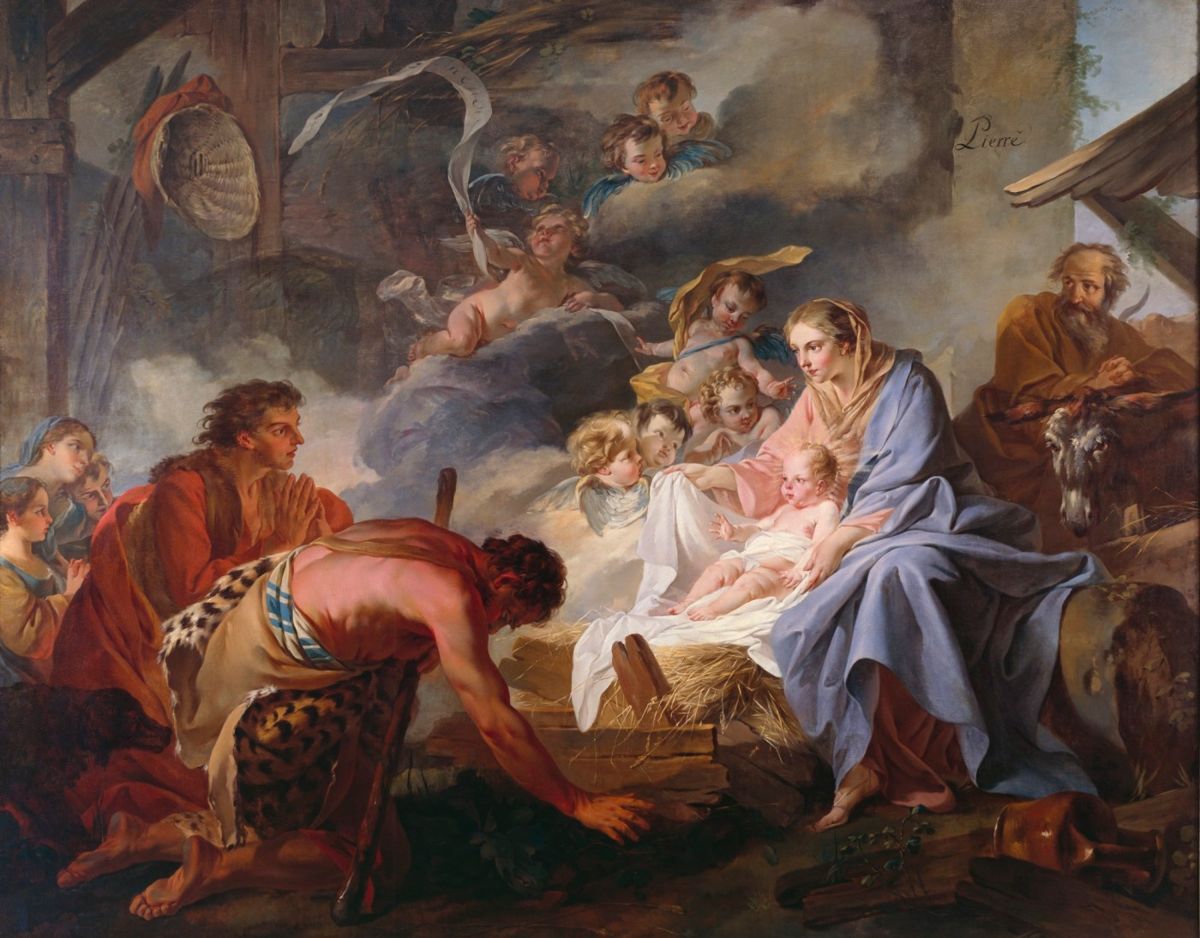
In the 18th century, with the spread of Rococo taste, the depiction of the Madonna and Child moved away from Baroque dramatic tension to embrace a lighter, more ornamental vision. Mary often becomes a figure of ideal beauty, set in elegant surroundings with idyllic landscape backgrounds and pastel colours.
In these images the theological component tends to be implicit, sublimated into the aesthetics of maternal love, understood more as universal affection than as a specific Christological narrative. The image of Mary gradually loses its hieratic quality, becoming a symbol of grace and sweetness, as in the refined Madonnas painted by Jean-Baptiste Marie Pierre and François Boucher.
Jean-Baptiste Marie Pierre, The Adoration of the Shepherds, 1745
7. Modernity and twentieth-century experimentation
With the end of the 19th century and the arrival of modernity, the Madonna and Child lost its status as a canonical image and was reinterpreted in personal, often problematic terms. Modern art, freed from ecclesiastical patronage, reread the subject in ways that were often irreverent or existentialist.
Artists such as Otto Dix depicted the Madonna as a symbol of protection in a world torn apart by war, while others such as Salvador Dalí or Andy Warhol questioned the very nature of the image, overlaying sacred and profane, simulacrum and pop icon.
This phase marks the definitive transformation of the Madonna from a dogmatic subject into a means of reflecting on the human condition, motherhood and cultural identity.
Salvador Dalí, The Madonna of Port Lligat, 1950
Conclusion
The depiction of the Madonna and Child has passed through historical eras and aesthetic transformations while remaining ever relevant, able to convey complex and profound meanings. From the archetype of divine motherhood to the portrayal of human love, its image has never stopped evolving, reflecting each time the cultural, theological and emotional tensions of the world that produced it.
Essential bibliography
- Belting, H. (1990). L’immagine e il suo pubblico nel Medioevo. Laterza.
- Goffen, R. (1986). Renaissance Rivals: Michelangelo, Leonardo, Raphael, Titian. Yale University Press.
- Hall, J. (1974). Dictionary of Subjects and Symbols in Art. Harper & Row.
- Lavin, M. (1968). The Place of Narrative: Mural Decoration in Italian Churches, 431–1600. University of Chicago Press.
- Panofsky, E. (1953). Early Netherlandish Painting: Its Origins and Character. Harvard University Press.
- Schiller, G. (1971). Iconography of Christian Art. Lund Humphries.
- Toman, R. (ed.) (1998). L’arte del Rinascimento. Könemann.
Some images in this article are hosted on external sites and open in a new tab.
🇮🇹 Leggi l’articolo originale in italiano →