Flower of Life
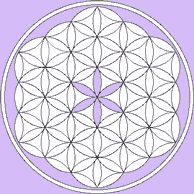 The flower and the bud are universal symbols of youth. Because the arrangement of its petals resembles a star, the flower is also associated with the sun, the globe or the centre. Innocent heralds of spring, flowers symbolise vitality, the end of winter and the victory of life over death.
In Christian symbolism the cup, open at the top, suggests the receiving of God's gifts but also the transient nature of earthly beauty, which can endure only in the gardens of Paradise. This helps explain the ancient custom of placing tombs within gardens or adorning them with flowers. Since the first Christian churches housed the tombs of martyrs, those same churches were decorated with floral motifs.
In Taoism a "golden bud" growing from the crown of the head symbolises the highest mystical enlightenment.
In Aztec culture Xochiquetzal, literally "the flower that stands upright", was the name of the goddess associated with fertility. Also in Aztec culture, the "flower wars" were ritual battles between neighbouring Aztec states whose sole purpose was to capture prisoners to be sacrificed on the altars of both rival sides.
The Flower of Life, however, cannot be considered a simple decorative floral stylisation, because in its apparent simplicity it condenses an elaborate geometric conception. The figure is in fact constructed by overlapping several circles that intersect according to a precise pattern. The circles all have the same diameter and are evenly spaced, so that the centre of each circle lies on the circumference of its neighbour, intersecting one another in a hexagonal pattern. The immediate visual result is the harmonious repetition of a six-petalled figure enclosed in hexagonal arcs, which is in turn inscribed in a circle.
With its six petals, the Flower of Life symbolises the number 6 itself. Six is associated with structural order and perfect harmony. In the Scriptures, six are the days devoted to the creation of the cosmos. The number 6 has particular mathematical properties, being the first perfect number. Six is in fact both the sum and the product of the first three whole numbers (1+2+3=6 and 1x2x3=6). Three-dimensional space itself is defined by six directions: forward, backward, left, right, up and down. In solid geometry the six directions can be contained in the six faces of a cube, the six vertices of an octahedron and the six edges of a tetrahedron, also known as Platonic solids. In plane geometry, the Pythagorean triangle with sides 3, 4 and 5 has both an area and a semi-perimeter equal to 6. The number 6 also recurs in several crystal structures, such as those of snowflakes, quartz and graphite. Above all, the number 6 is the cornerstone of the geometry of life, because a structure of six carbon atoms arranged in a hexagon is a fundamental structure of organic chemistry.
Bibliography:
- Quadrivium - Numero, geometria, musica, astronomia (Quadrivium: Number, Geometry, Music, Heaven). Sironi Editore 2011.
- Dictionary of Symbolism - Cultural Icons & The Meanings Behind Them; Hans Biedermann; Meridian 1994.