The Church of San Tommaso in Caramanico Terme
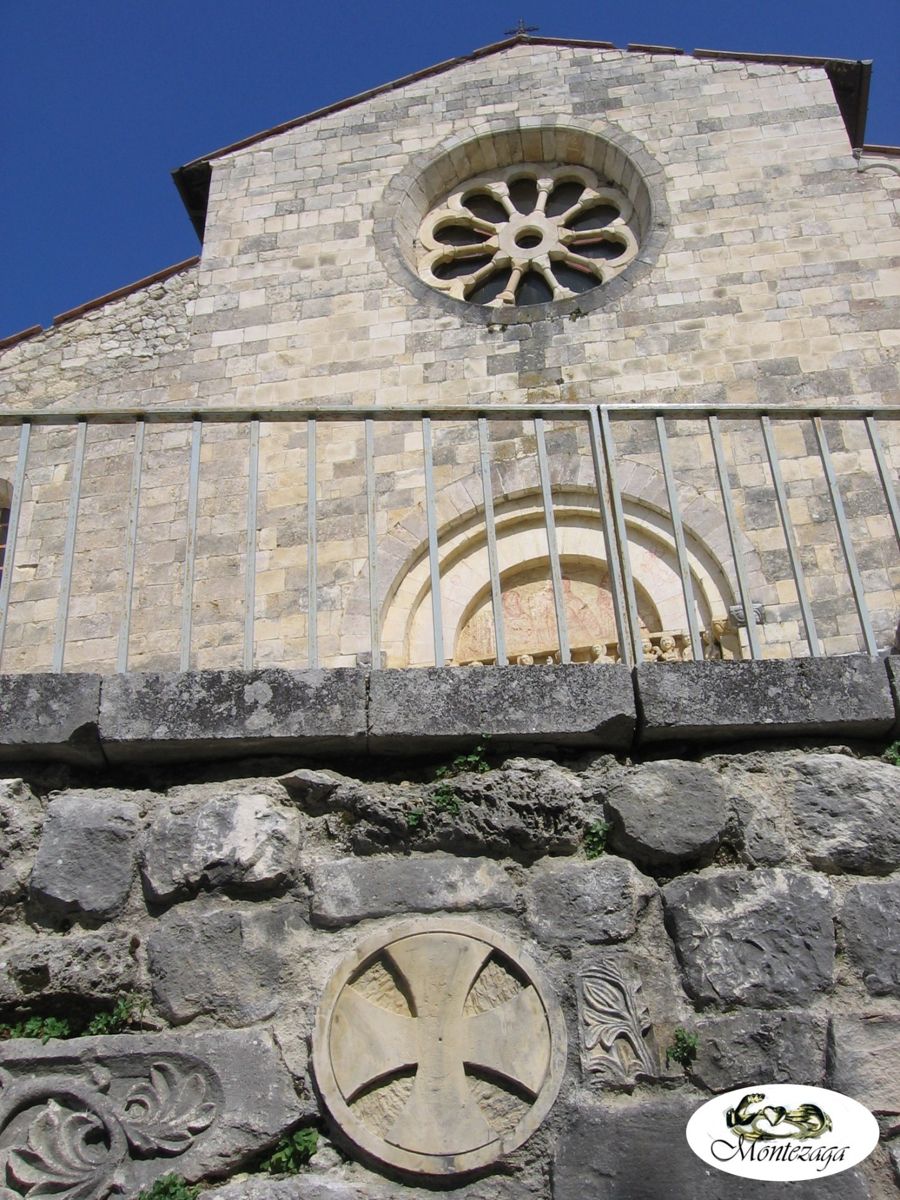 Ferragosto (15 August) 2009: it is a bright day, and we leave the sparkling Abruzzo sea behind us to venture into the mystical places of the Apennines, crossing the valleys of the Majella and Monte Morrone. On the SP66 road, about 6 km from Caramanico Terme, in the hamlet of San Tommaso, stands a church originally dedicated to Saint Thomas Becket, the Archbishop of Canterbury murdered in his cathedral in 1170. The church was founded in the years immediately afterwards. Its construction was financed by the Norman feudal lord Riccardo Trogisio. In 1219 Honorius III granted it apostolic protection, and in 1260 Alexander IV formally established a community of Augustinian canons regular there. To escape diocesan authority, in 1264 the canons of San Tommaso placed their church under the jurisdiction of the monastery of San Lorenzo fuori le Mura in Rome, while continuing to follow the Rule of Saint Augustine. In 1334, because of a long dispute with the bishops of Chieti and constant harassment by laymen, they submitted to the Abbey of Santo Spirito del Morrone, adopting the Rule of Saint Benedict. The monastery was later suppressed in 1652, but the church continued to be served by the Celestines until the Napoleonic suppression of 1807.
 The history of the construction of this church, which preserves all the features of a Romanesque building, was particularly troubled. Historical sources say that building began in 1202 and that the originally grandiose project included a portico, a pulpit, compound pillars inside and numerous sculptural decorations by great master stonemasons. By 1219 construction was already finished and the original project considerably simplified, for unknown reasons. The portico was never built, but the pillars that were to support it are still visible on the façade. The ambo too, of which finely carved column-bearing lions survive, was never completed. Two windows not foreseen in the original design were inserted in the façade, and the sculptures already prepared were set in place rather imprecisely.
But before we delve into the unusual architectural and decorative features of this extraordinary church, which undoubtedly make it the most interesting of the many religious buildings in the Caramanico area, we need to go back in history to the period before its construction, or rather its reconstruction.
The San Tommaso area was already known in the 8th century AD as Paternum and was crossed by an important road, still visible in the early 19th century in Rizzi Zannoni's Atlas, which ran up from Interpromium into the territories of Bolognano and Musellaro and then crossed to the right bank of the Orta river near Musellaro. The maps also show the Luco bridge, a stone bridge spanning the river's deep gorge, a true canyon, whose remains still survive in the Luchi district of San Tommaso.
It was precisely along this route, within the hamlet of San Tommaso itself, that various remains of an important ancient sanctuary were found in the first half of the 1900s: a stone pillar with a square base, a limestone head of Jupiter and, above all, some forty small bronze statues of Hercules dating from the 3rd–2nd century BC, important evidence of the place of worship used by the local peoples since before full Romanisation. Hercules is undoubtedly the most typical deity of the Italic religious pantheon, symbolising courage and physical strength. Because of these qualities the god was often associated with springs and healing waters and invoked to protect them. To understand the meaning of the symbolism so skilfully displayed by the builders of the church of San Tommaso, we also need to emphasise the natural setting of this place, which in our view was fundamental in the choice of site for a place of worship. The municipality of Caramanico is known not only for its healing thermal waters but also for the Orfento Valley Nature Reserve, a sanctuary of nature, a green island in the wild valley carved by the river Orfento. The reserve covers 2,606 hectares, rising from 500 to 2,600 metres above sea level, clothed in immense, lush beech forests cut by numerous canyons full of water and thundering waterfalls, and it is home to many animal species, some of them rare, and to abundant fish life. No words can do justice to this extraordinary spectacle.
In the same way, one is captivated by the sudden sight of the church of San Tommaso standing out on the edge of the valley, by its solitary elegance and by its compact ochre structure, mottled by the marks of time.
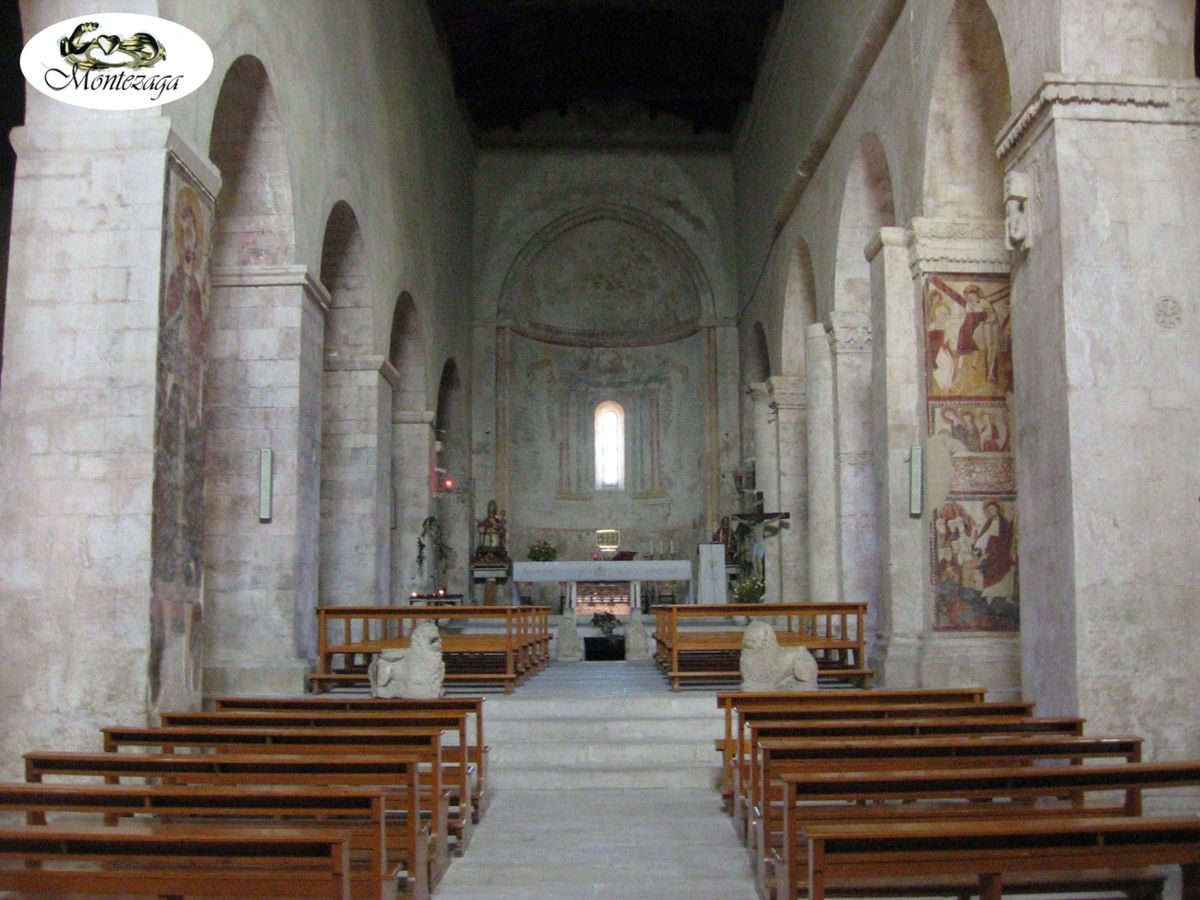 The building has a three-aisled plan with a single semicircular apse. The façade mirrors the internal divisions, with a central portal and two side portals corresponding to the aisles.
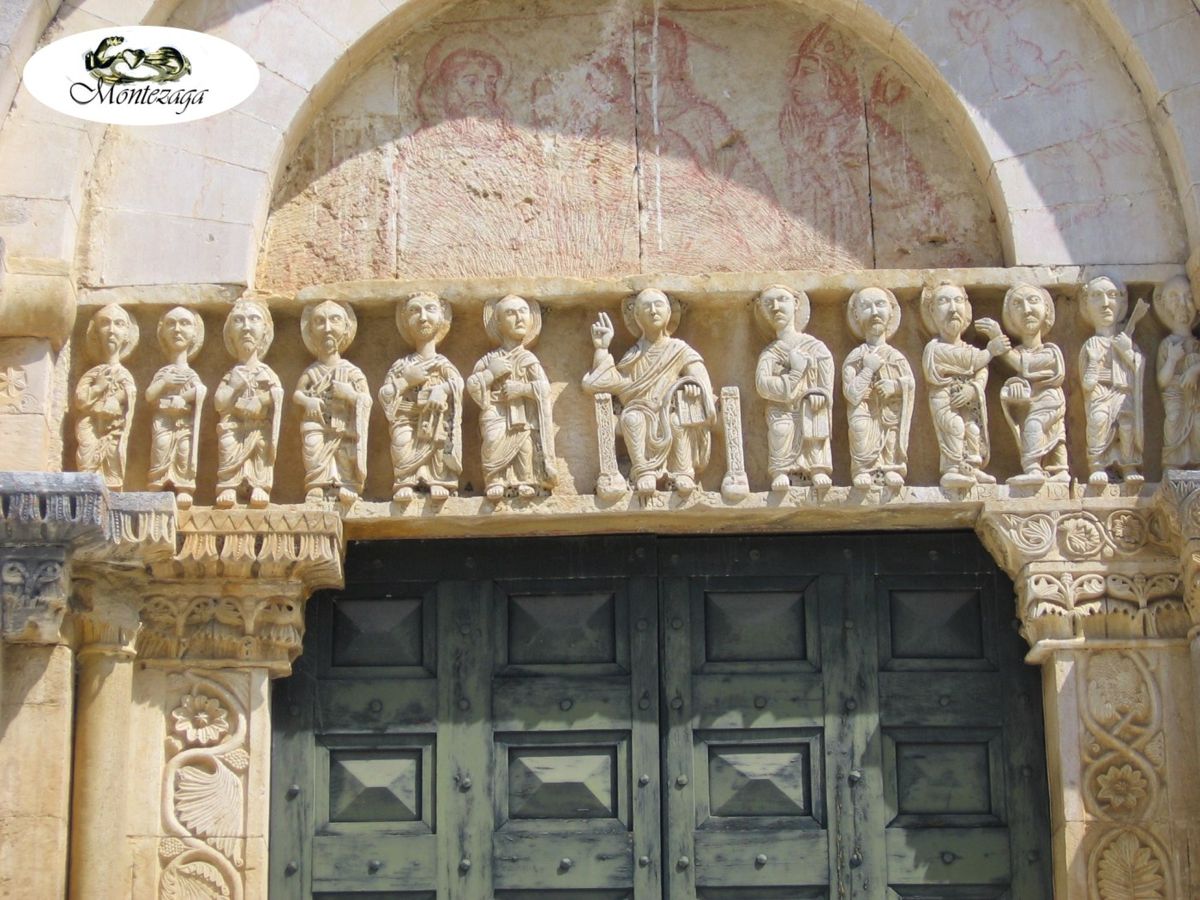
On the lintel of the central portal stands out the splendid high relief of Christ enthroned in blessing with the twelve Apostles (photo 002). In the sculptural group the figures are clearly out of proportion with the lintel and with the whole façade, as if adapted from a more imposing original design. The depiction of the apostles is also unusual, with commanding hand gestures that differ from one to the next, as if they wished to convey a solemn message, reinforced by the severity of their gaze.
We are still caught up in the majesty of the natural spectacle we have passed through, which has accompanied us all the way here, and it seems natural to see rich floral elements reproduced in stone, counterbalancing the severity of the figures on the lintel. The spirals of the floral motifs flanking the portal intertwine with natural elegance, blossoming into palmette capitals.
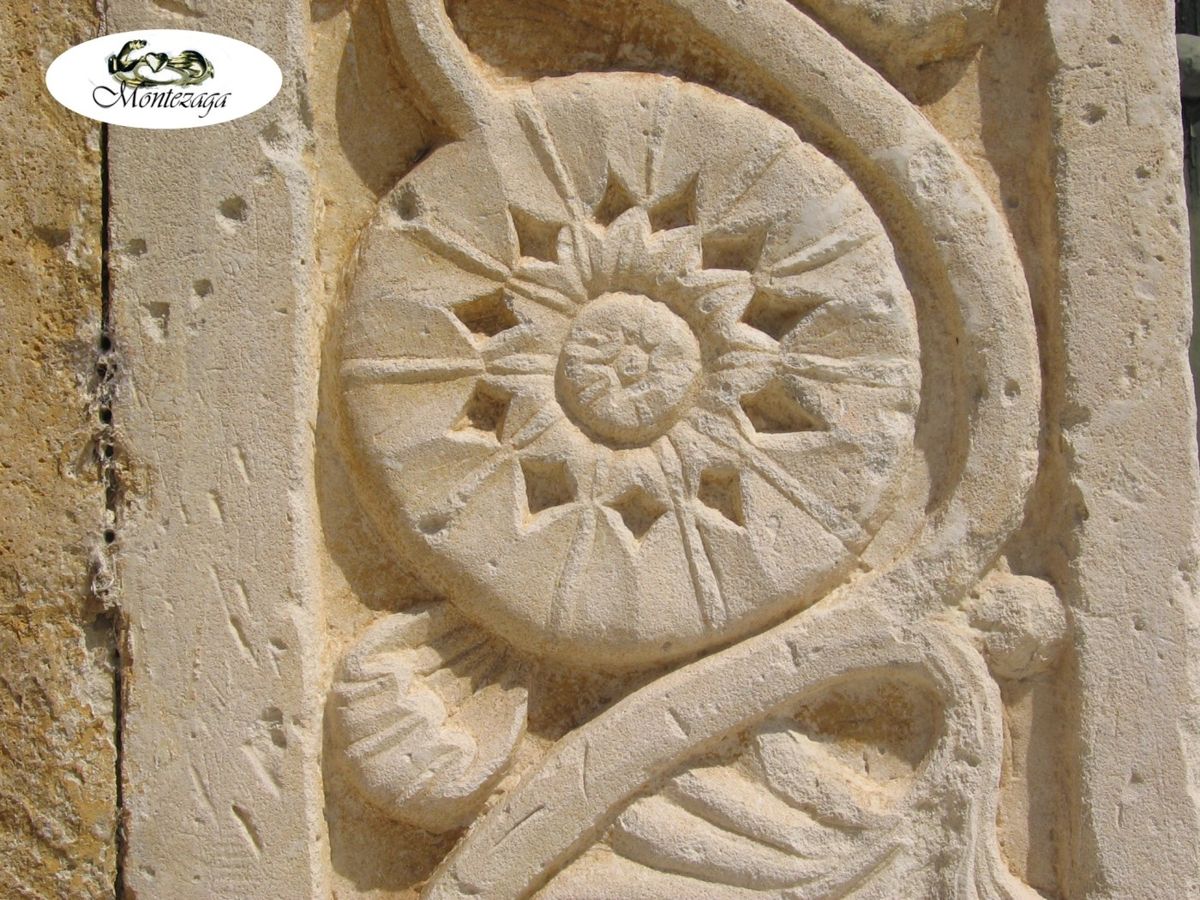
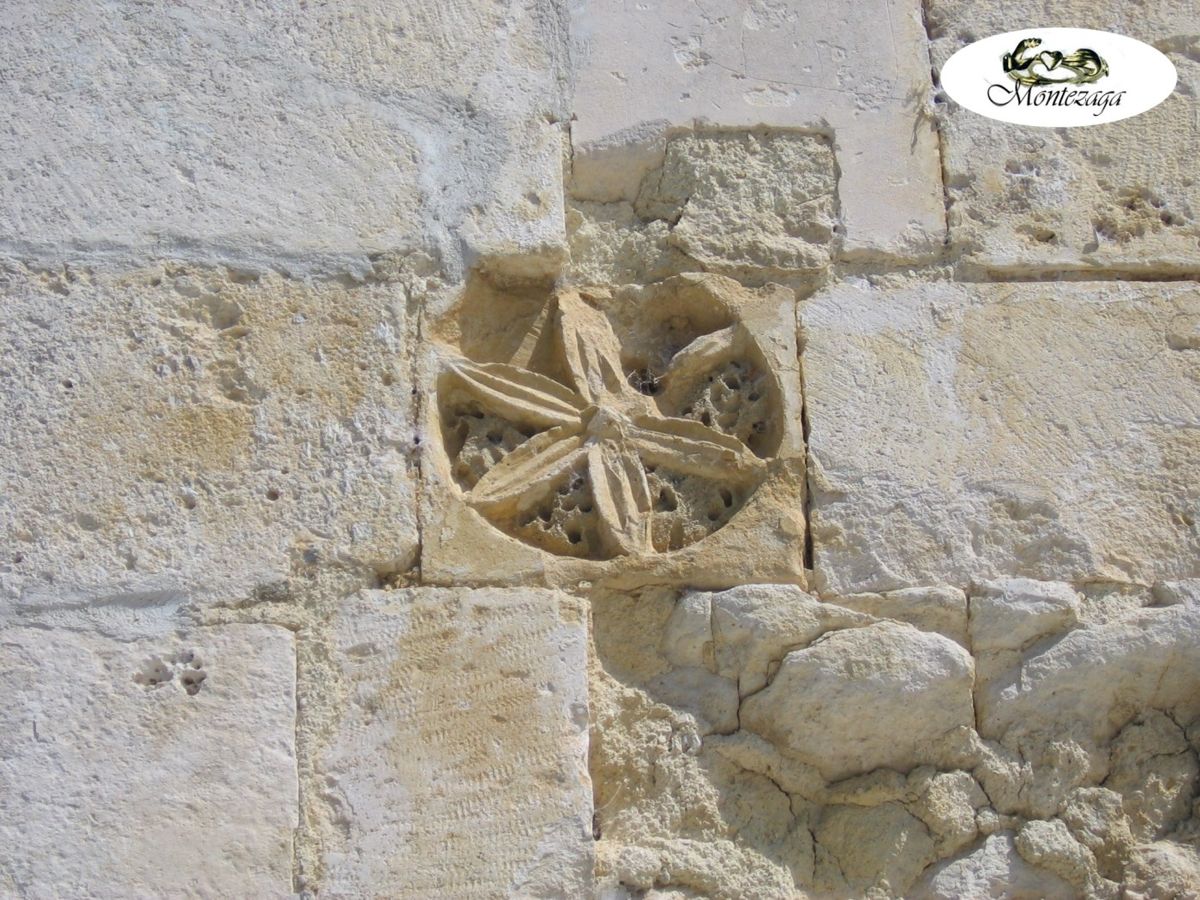
The eye follows the floral bas-reliefs of the façade until it meets isolated panels reproducing, in solitary beauty, perfect Flowers of Life, an ancient and universal motif found in both Eastern and Western cultures as a solar symbol, illustrating the inner structure of creation and expressing, through the golden ratio, the harmonious geometry of nature.
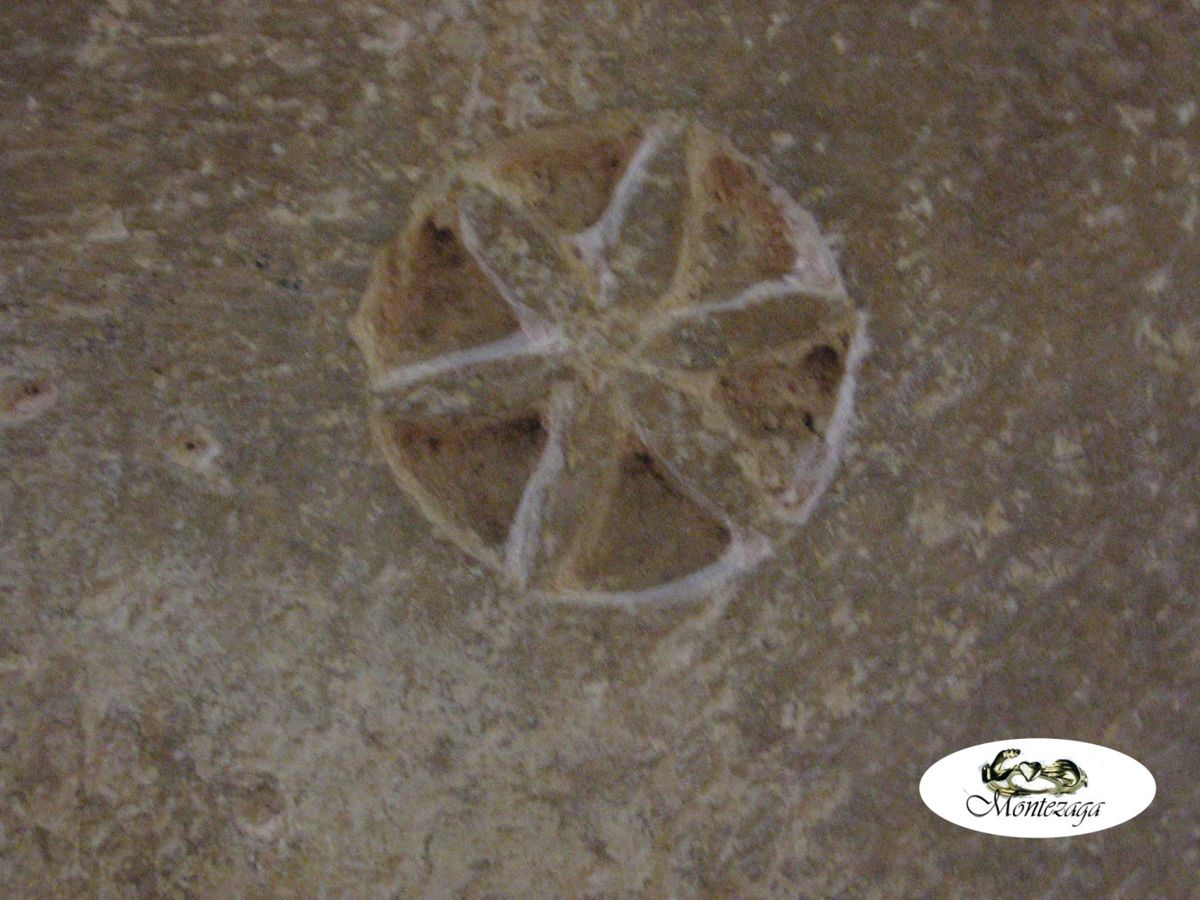
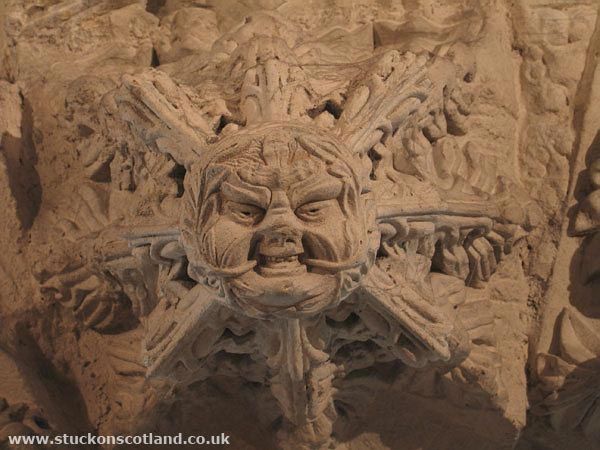
Other flowers of life can be found inside the church, carved on columns. But then, on another solitary panel, we meet the sarcastic grin of a Green Man sprouting foliage: an unexpected encounter with another universal symbol. The Green Man, in his various forms, is connected with pagan woodland deities, primarily identified with the spring reawakening of nature and therefore a symbol of cyclical rebirth. The famous Rosslyn Chapel in Scotland, known for its rich and much-debated symbolism and for its link with the Order of the Knights Templar, has more than a hundred depictions of him. But this does not seem to be the only link between the two churches.
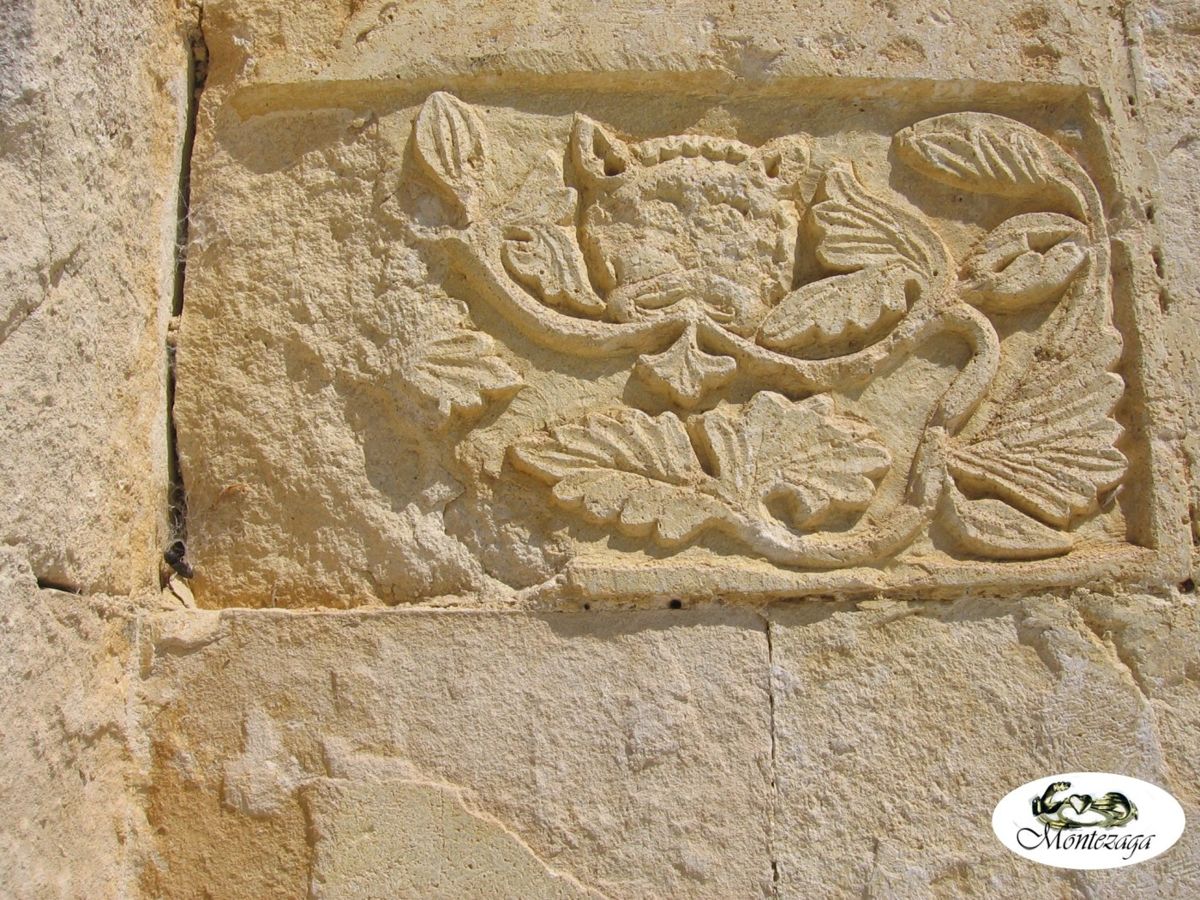
Not far from the Green Man stands out the bas-relief of what looks like a corn cob in a row of maize. This leads us to consider the date of construction of the church of San Tommaso (AD 1202), the later discovery of the New World (AD 1492) and the much-debated transatlantic voyages of the Knights Templar.
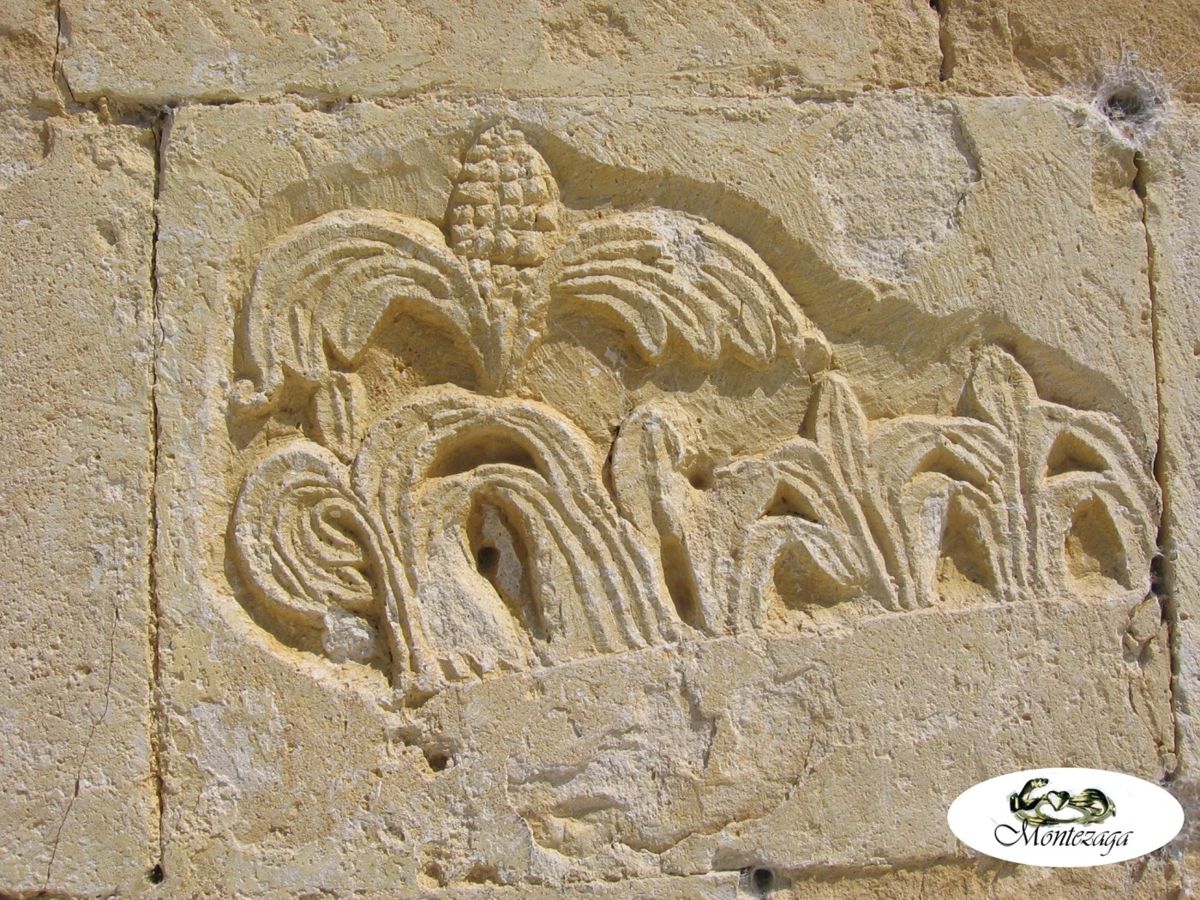
To the right of the portal, a panel shows the single coil of a snake, upside down. This inverted depiction strikes us as odd, so we decide to rotate the photograph by 180° to see it more clearly.
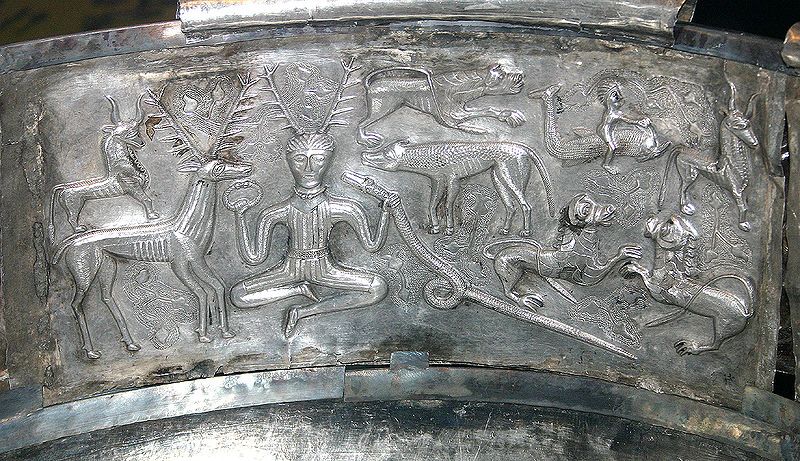
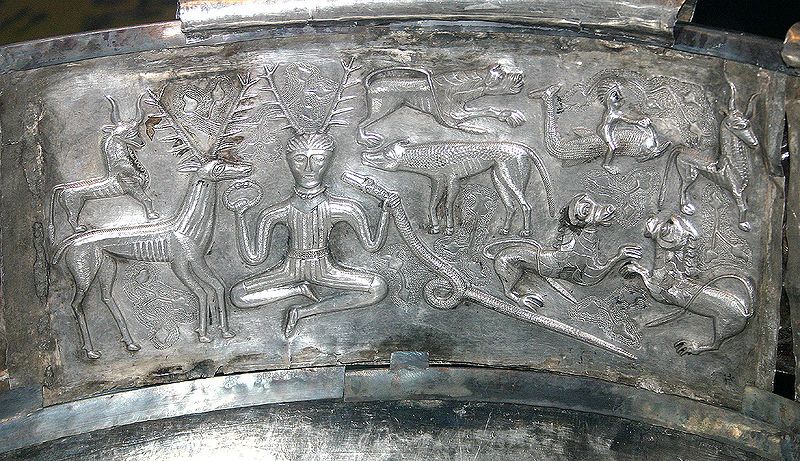
And so it is revealed as a horned serpent with what appears to be a collar (perhaps a torc). This peculiar motif brings to mind a typical element of the complex figure of Cernunnos, whose best-known depiction is on the Gundestrup Cauldron, of Celtic origin (1st century BC). Cernunnos, usually depicted with long, slender stag's antlers and surrounded by wild animals, is in Celtic mythology the god of nature who rules over all wild animals and forests, and he is also considered a god of virility. He is usually adorned with a torc around his neck and holds a horned serpent in one hand, while with the other he displays a torc which, in mythological tales, is given to an adept as a sign of initiation. But the depiction of Cernunnos is even older, as it already appears in the rock carvings of Valcamonica (4th century BC).
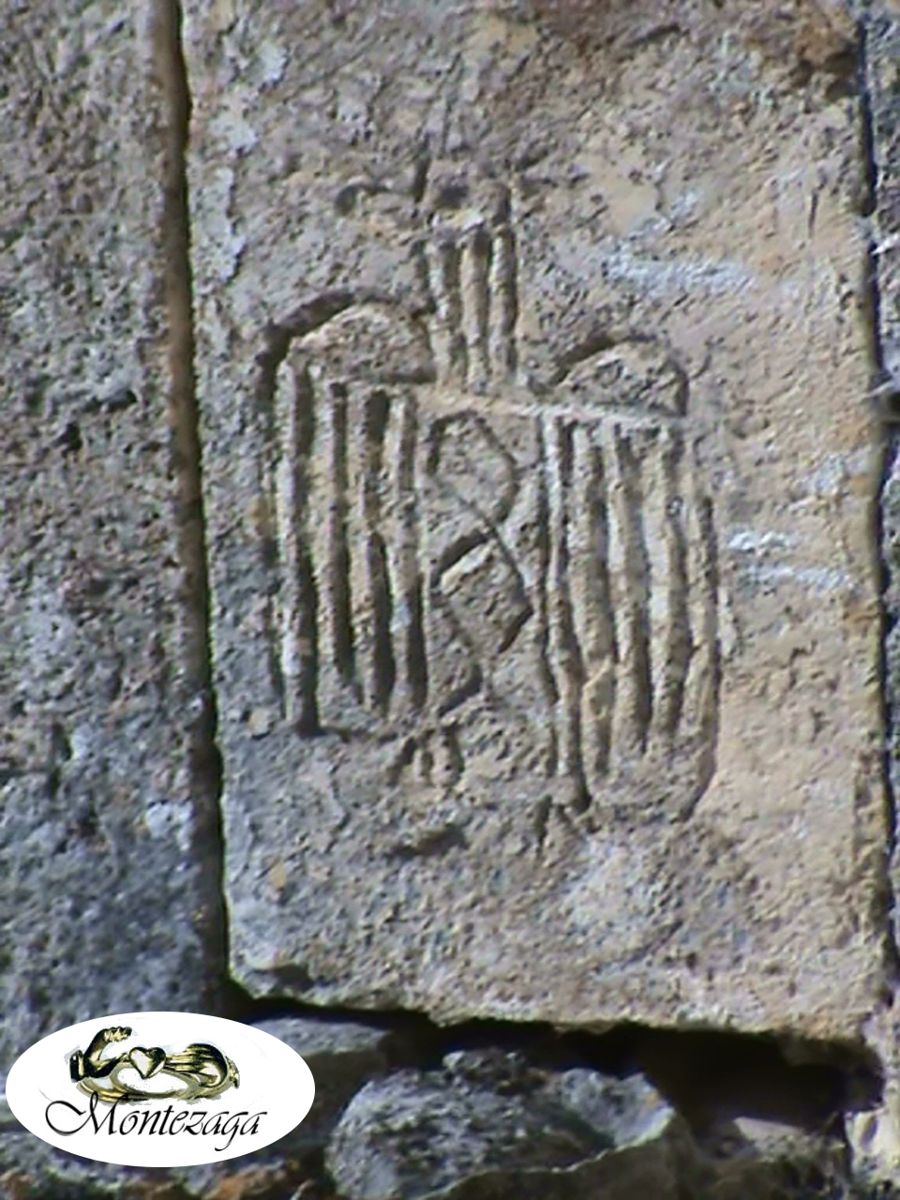
Finally, carved high up and on its own, appears what seems to be a stylised eagle in flight.
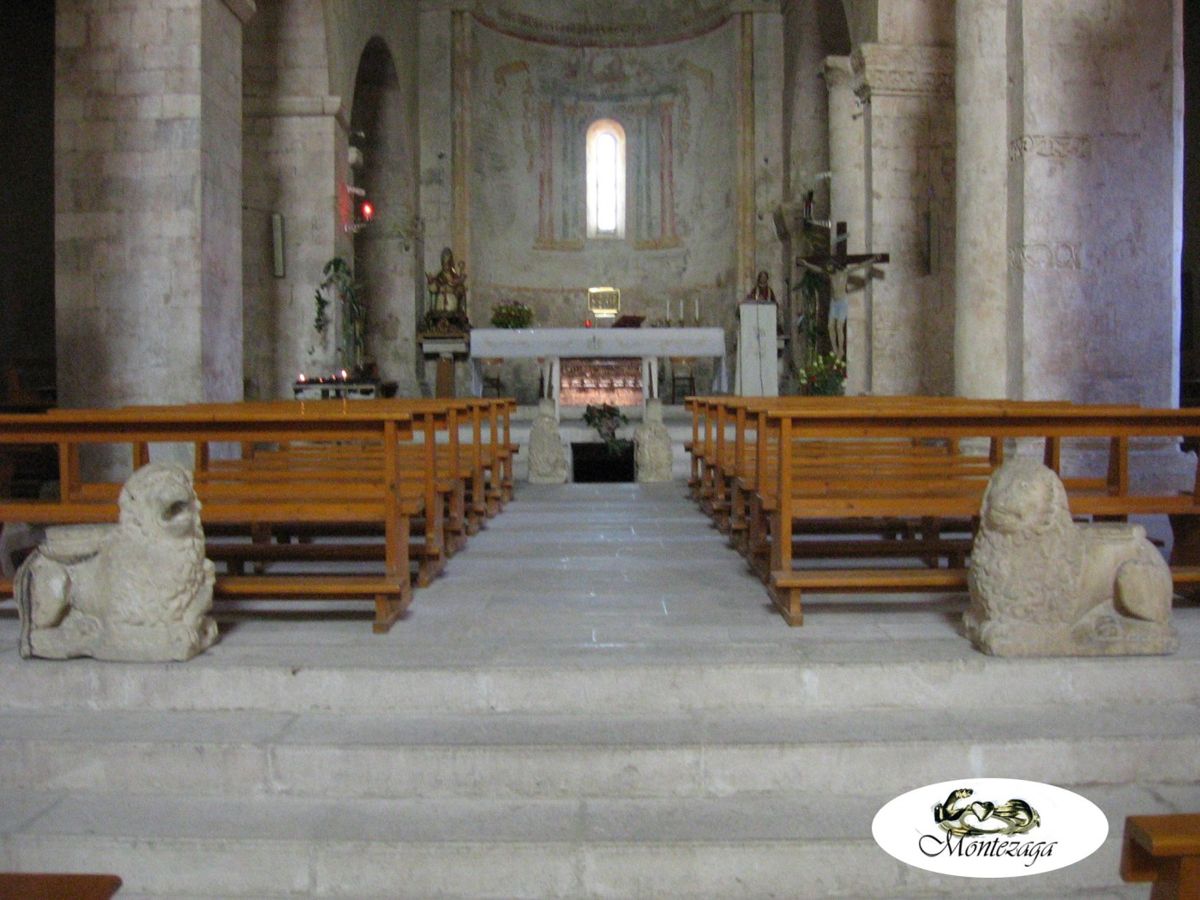
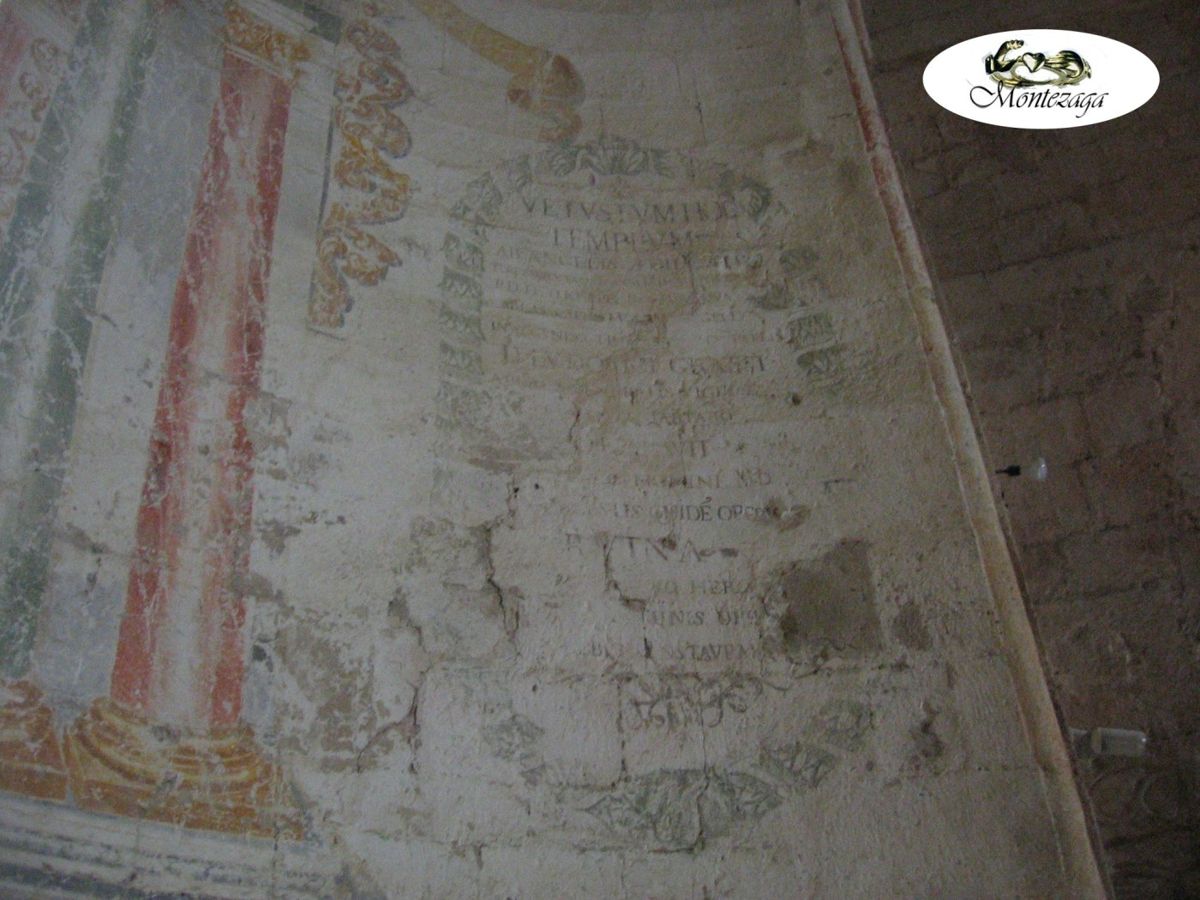
 On this hot mid-August day we are welcomed by the cool aisles of the church and by the unusual presence of four column-bearing lions, almost standing guard over the nave and the crypt. Frescoes of four red and green columns, arranged symmetrically around a bright central single-light window, crown the altar. The illuminated apse reveals an only partly legible inscription confirming the sacredness and antiquity of the place, already known to the builders of the present church (Vetustum Hoc Templum...).
Among the various 13th-century frescoes inside the church, of particular interest is the one of Saint Christopher painted on one of the pillars of the nave.
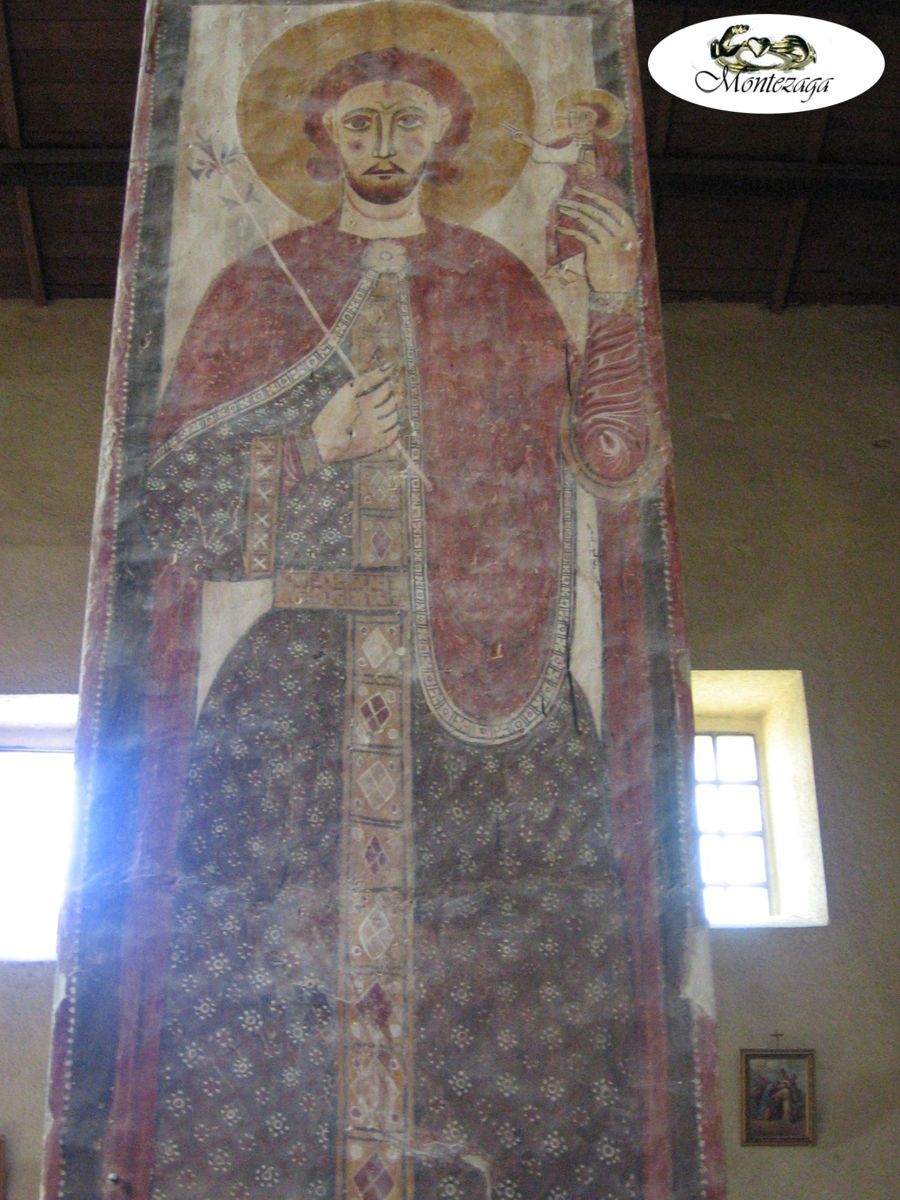
To grasp the symbolic meaning of this depiction within this particular church, it is useful to recall the legend of the saint as told by Amédée de Ponthieu in his Légendes du Vieux Paris:
"Before he became a Christian, Christopher was called Offerus; he was a kind of giant, and very slow-witted. When he came of age, he set off on a journey, saying that he wanted to serve the greatest lord on earth. He was advised to go to the court of a very powerful king, who was delighted to have such a strong servant. One day the king, hearing a minstrel utter the name of the devil, was terrified and made the sign of the cross. 'Why do you do that?' Christopher asked at once. 'Because I am afraid of the devil,' the king replied. 'But if you fear him, then you are not so powerful after all? Then I want to serve the devil.' And with that, Offerus left the court. "After a long march in search of this mighty monarch, he saw a great troop of knights dressed in red advancing towards him; their leader was black and said to him: 'What do you want?' 'I am looking for the devil, to serve him.' 'I am the devil; follow me.' And so Offerus found himself enlisted among the servants of Satan. One day, during a long ride, the infernal troop came upon a cross by the roadside and the devil ordered them to turn back. 'Why?' asked Offerus, always eager to learn. 'Because I fear the image of Christ.' 'If you fear the image of Christ, it means you are less powerful than he is, so I want to enter the service of Christ.' Offerus passed the cross alone and went on his way. He met a good hermit and asked him where he might see Christ. 'Everywhere,' the hermit replied. 'I don't understand,' said Offerus, 'but if you speak the truth, what services could a strong, quick young man like me render him?' 'You must serve him,' the hermit replied, 'with prayer, fasting and vigils.' Offerus pulled a face. 'Is there no other way to win his favour?' he asked. The hermit understood whom he was dealing with and, taking him by the hand, led him to the bank of a raging torrent that came down from a high mountain. There he said to him: 'Many poor people who have crossed this water have drowned; stay here, and carry across on your strong shoulders those who ask you. If you do this for the love of Christ, he will recognise you as his servant.' 'I will gladly do it for the love of Christ,' Offerus replied. So he built himself a hut on the bank and, day and night, carried across the travellers who asked him. "One night, worn out with fatigue, he was fast asleep when he was woken by knocking at the door, and heard the voice of a child calling him by name three times! He got up, set the child on his broad shoulders and stepped into the torrent. When he reached the middle of the riverbed, he saw the torrent suddenly swelling and growing ever more threatening; the waves rose and hurled themselves against his sinewy legs to knock him over. He did his best to resist, but the child weighed like a heavy burden; then, fearing he might drop the little traveller, he uprooted a tree to lean on. But the waters rose still higher, and the child was growing heavier and heavier. Offerus, afraid of seeing him die, raised his head towards him and said: 'Child, why are you becoming so heavy? I feel as if I were carrying the whole world.' The child replied: 'Not only are you carrying the world, but also the one who made the world. I am Christ, your God and your master. As a reward for your good service, I baptise you in the name of my Father, in my own name and in that of the Holy Spirit; from now on you shall be called Christopher.' From that day on, Christopher travelled the world teaching the word of Christ." The figure of Saint Christopher, the Christian symbol of pilgrimage and of the inner journey towards the truth of Christ's word, is also a symbol of great importance in Hermetic doctrine. The name Christopher is traditionally understood to mean "he who carries Christ", but phonetic cabala reveals another meaning hidden in the name: Chrysophoros, "he who carries gold". In alchemical terms he represents, as Fulcanelli states, a true "hieroglyph of solar sulphur, or nascent gold, raised upon the mercurial waves and then carried, by the very energy of this mercury, to the degree of power possessed by the Elixir." The fervent devotion the saint enjoyed in the Middle Ages matched the high symbolic value the alchemists attributed to him. The symbolic analogy between this rough giant carrying Christ and the primitive matter that conveys gold, which plays a role of primary importance in the Alchemical Work, is further reinforced by pictorial details that seal their union. That the painter of the fresco knew this meaning, or at least faithfully reproduced its symbolism, is shown by the precise choice of colours for the saint's clothing: according to Aristotle, the emblematic colour of mercury is grey or violet, exactly as Saint Christopher is depicted. This is even more evident in the motif of the belt quilted with criss-crossing lines similar to those which, according to the alchemists, form on the surface of the mercurial solvent "when it has been canonically prepared". These geometric forms persist and appear more sharply defined when gold is dissolved in the mercurial solvent to bring the noble metal back to its primitive state, that of "young or rejuvenated gold, alias Child Gold". Christopher, bearer of the Christ Child, becomes Chrysophoros (Mercury), bearer of Young Gold, in its ultimate meaning of perpetual regeneration. The refinement of the process seems to be underlined even further by the fact that the giant is not shown with the staff or uprooted tree of classical iconography, but with a slender flowering wand.
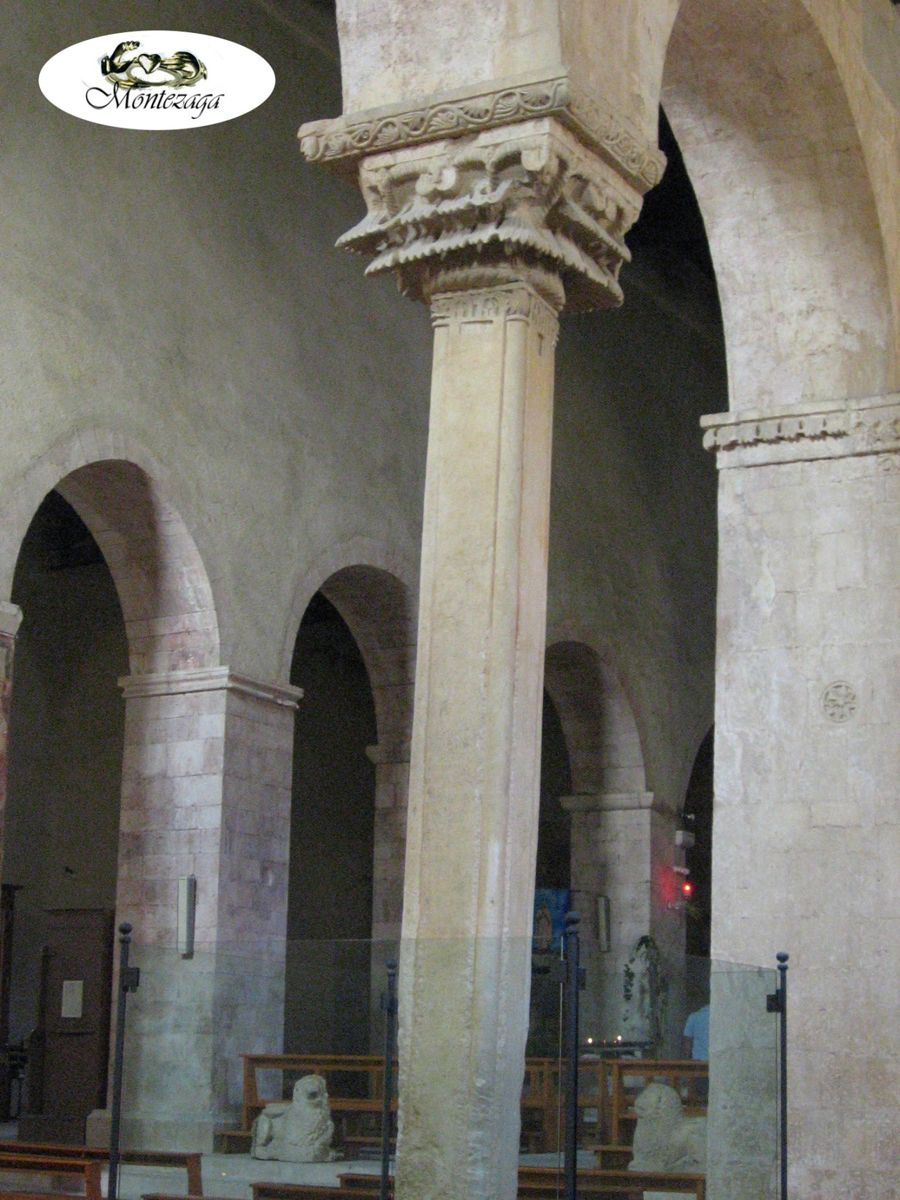
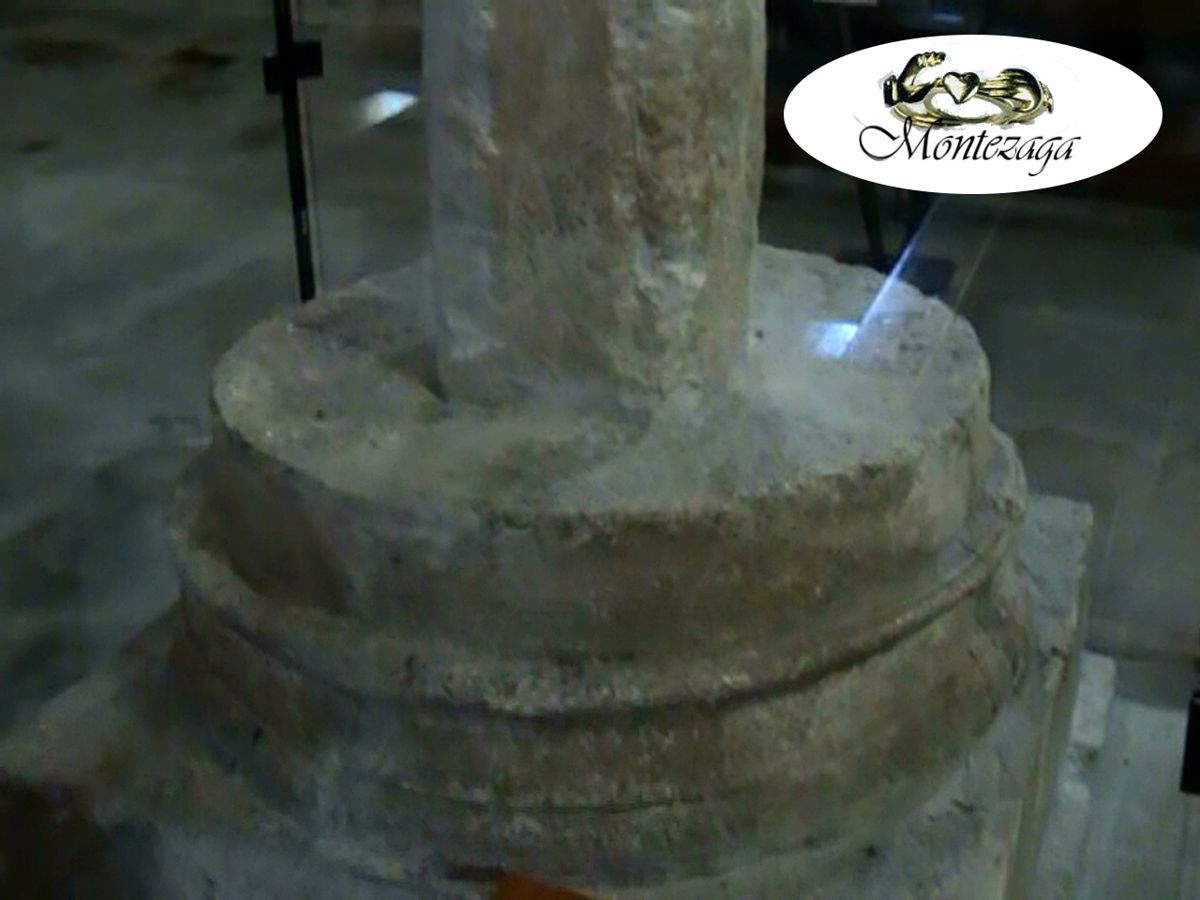
Another unusual feature of the church's interior is the so-called "Colonna Santa" (Holy Column). The column, square in section, stands in the right aisle and is unlike all the others: it is cut from a single block forming a slender shaft that rests on a disproportionately large plinth and is topped by an equally disproportionate capital, richly decorated with winding tendrils and palmate leaves. Amid the luxuriant vegetation, on one of its four corners, stands out the figure of another Green Man. The column is called Holy because popular tradition holds that it was brought to the site by an angel, and healing properties are attributed to its stone.
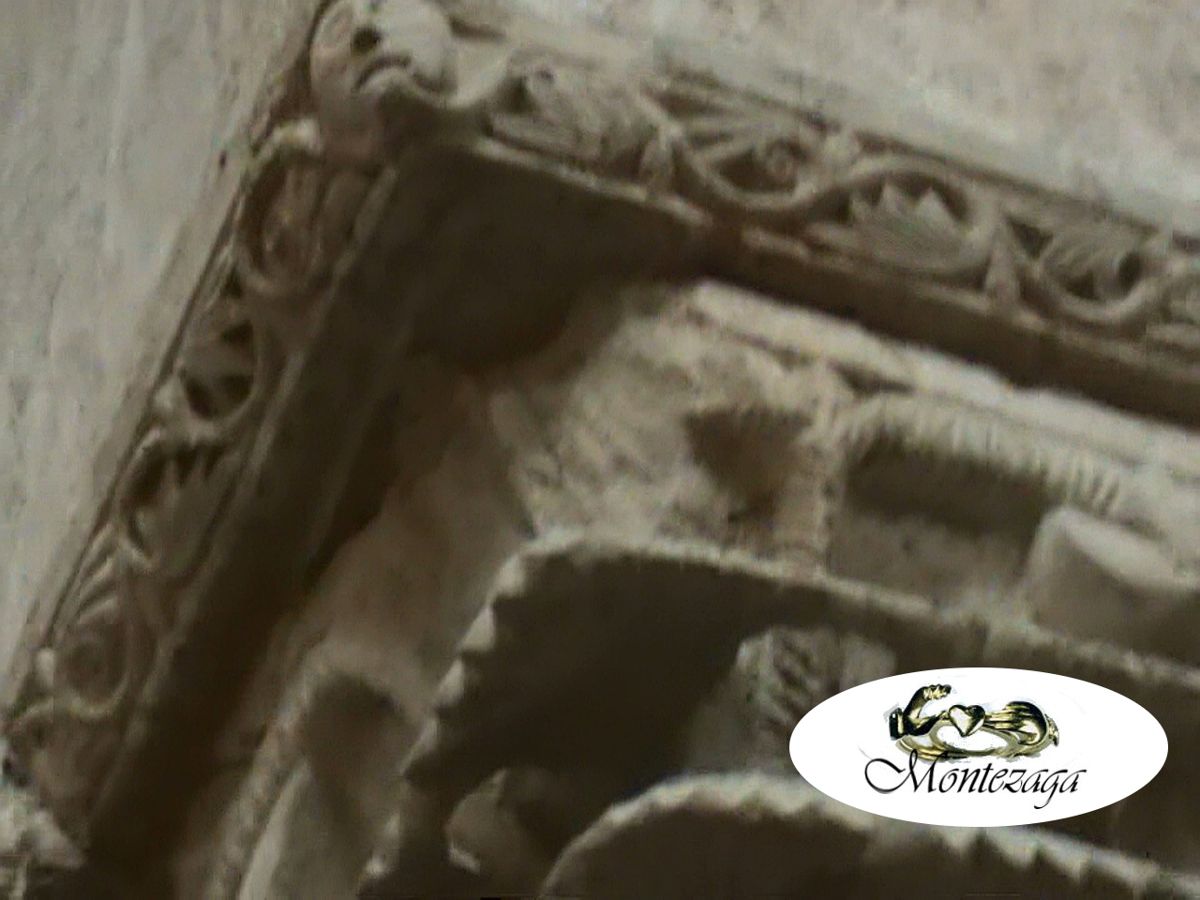
The column is now enclosed in protective glass. Its cult is deeply rooted and certainly not extinct, as shown by the fact that its lower part is markedly thinned and in places worn away by the rubbing of the faithful and by the removal of fragments. Its architectural difference and the particular popular devotion it receives, decidedly pagan in character, lead us to deduce that the column probably originally belonged to another place of worship, most likely the same one whose remains were found in the 1900s (see above), including a monolithic column with a square base.
Equally unusual, and in our view undoubtedly belonging to earlier pagan cults, is the well housed in the crypt beneath the altar, reached by a steep flight of steps watched over by two column-bearing lions. Sacred wells inside medieval Gothic churches are not a rarity. Historical descriptions of them exist in Paris at the abbey of Saint-Germain-des-Prés and at Saint-Marcel, in the Marne at the basilica of Notre-Dame de l'Épine, and in the church of Notre-Dame de Limoux in the Aude. The water drawn from these wells was considered to have great healing virtues and was used to treat certain illnesses. The presence of healing water in a sacred place also recalls the esoteric tradition of the Fountain of Youth, the legendary spring symbolising immortality and eternal youth found in the legends of many cultures. Also evocative is the symbolic link between this healing spring and the alchemical depiction of Saint Christopher as a mercurial symbol, otherwise known as the Fountain of Youth.
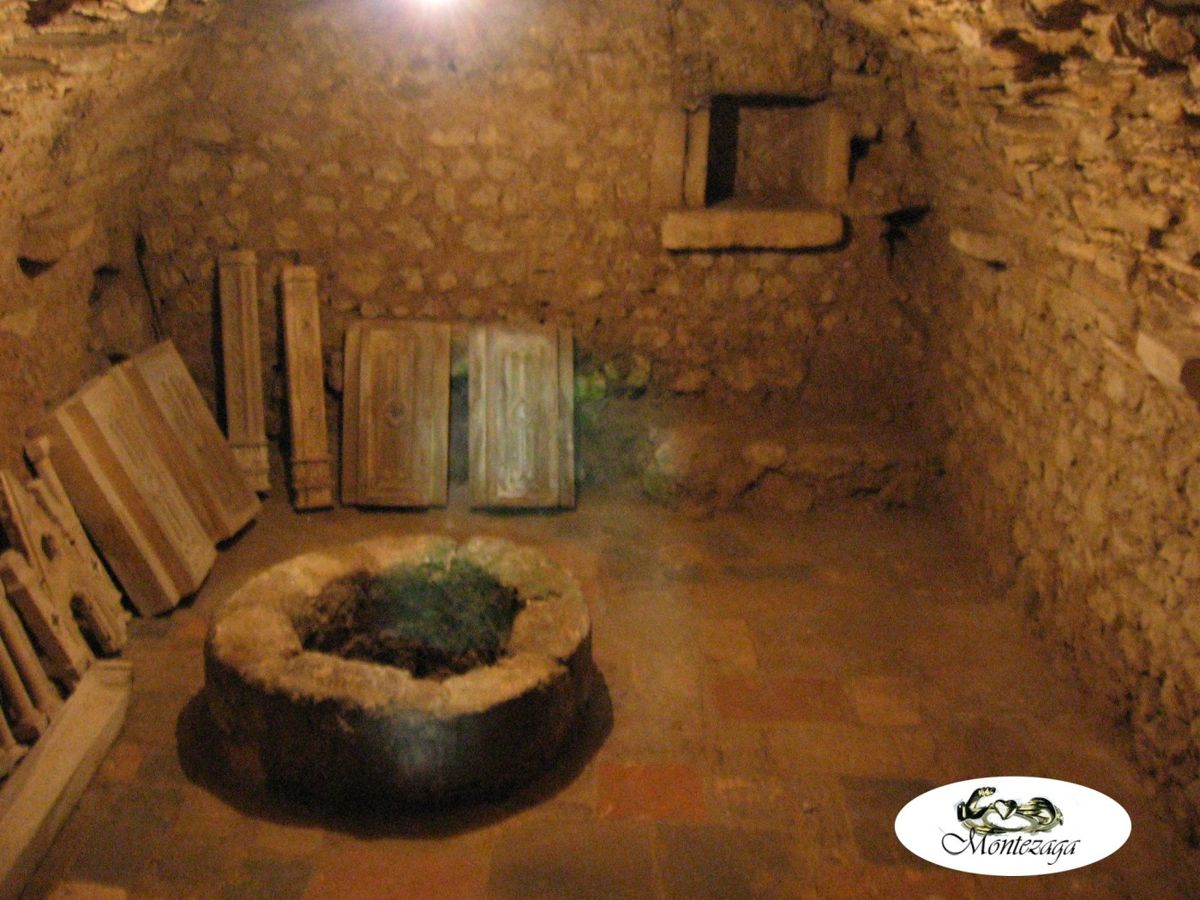
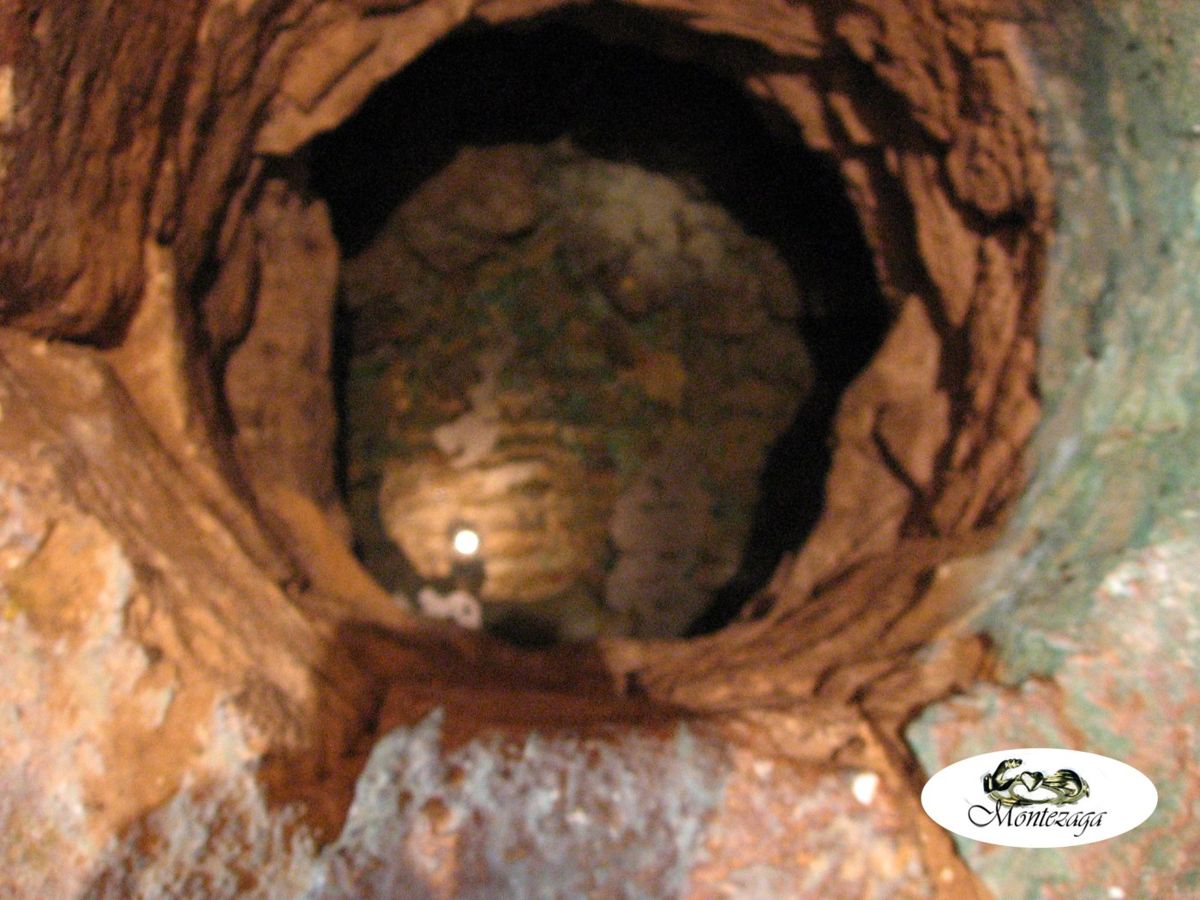
In our view the presence of this spring too should be linked to an earlier ancient place of worship, as suggested by the discovery in the area of some forty statuettes of Hercules, god of healing waters as well as indomitable warrior.
As we leave the incredible blend of pagan, Hermetic and Christian symbolism enclosed in this extraordinary church, a well-known symbol bids us farewell, as if to sum up its entire content in a single element: the cross pattée.
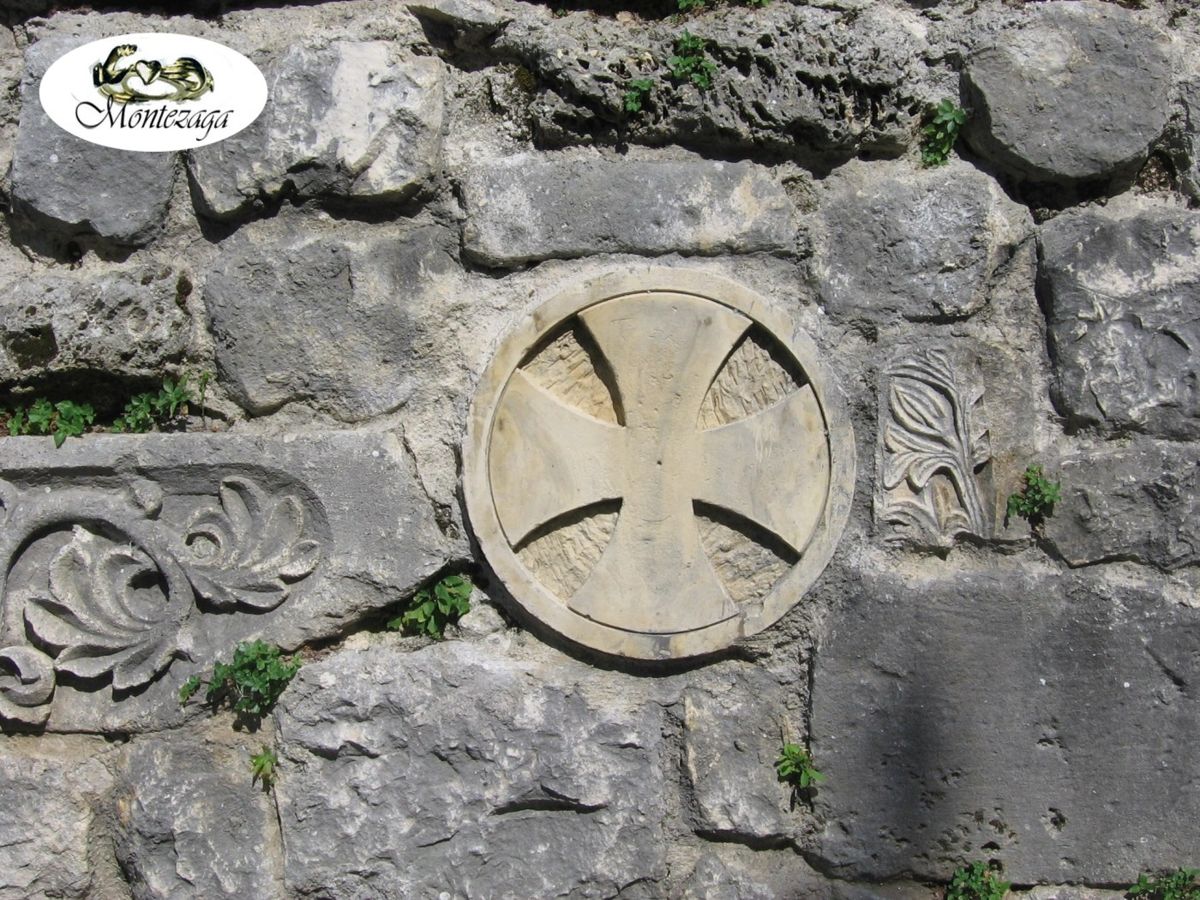
Although there is no explicit evidence connecting the history of this church with the order of the Knights Templar, several elements point to a possible link. Nor is there a definite historical link between the Templars and Thomas Becket. What is certain is that Thomas Becket was undoubtedly a figure of great fame and historical importance, venerated as a saint and martyr by the Catholic and Anglican churches after he was killed in Canterbury Cathedral (perhaps on the orders of King Henry II), and that several churches were dedicated to him.
One historical clue to a possible link lies in the funds the Templars received from Henry II for a new crusade to the Holy Land, as a kind of compensation for the archbishop's death. A further point of contact would seem to be the link with the Benedictine order, which hosted the Archbishop of Canterbury during his exile in France, and the well-known ties between the friars and the Knights Templar. The dedication to Thomas Becket of the church at Cabriolo (Parma), originally the chapel of a Templar house, also points to this possible link.
We came back, after a year in which we often caught ourselves thinking again about the enchantment of this work of art. We came back because we felt that something else would still astonish us. On our first visit we had looked for closer links between the site and Templar culture; now we hoped to find the ancient symbol of the Triple Enclosure, which is frequently associated with places belonging to the Templars. The search is not always easy, since the position in which it is found follows no precise rules, and it can escape notice, especially if the light does not fall at a grazing angle on the walls so as to bring out the carving.
Since the Triple Enclosure is found in various positions (walls, thresholds, cloister benches and floors), we carefully scrutinised the interior of the church for a long time and then, on the way out, its fine portals and the surrounding pavement, but no mark and no small intersection revealed the particular pattern.
To get a closer look at the walls, brightly lit by the sun, we used the telephoto lens of our video camera, which also allowed us to zoom in on the outer surfaces under the edge of the roof. And there at last a Triple Enclosure, partly hidden by later cement, revealed itself at a height of about 10 metres above the ground, on the rear east wall of the right aisle.
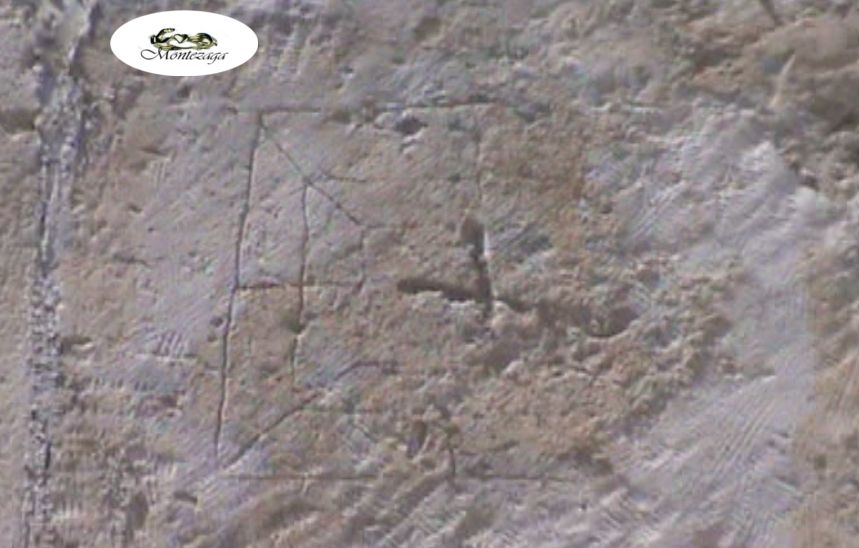
Its unusual position supports the hypothesis that it was used as a symbol, whose true meaning, however, remains unknown, and certainly rules out, at least in this case, its use as a tabula lusoria (game board).
So we venture a hypothesis: is the Triple Enclosure perhaps a trait d'union between the Benedictine monastic order and the Order of the Poor Knights of Christ and of the Temple of Solomon? We ask ourselves this question and promise to look for an answer in the monasteries of Abruzzo founded by the Benedictine order, whose monks played a fundamental role in launching the reconquest of the Holy Land. Let us remember, moreover, that in France, at the Council of Clermont in 1095, it was the Benedictines Abbot Hugh of Cluny and Pope Urban II, who had been prior of the same abbey, together with a small group of nobles including Godfrey of Bouillon, who shaped the decision to call the "First Crusade" to the Holy Land. From there would spring the enigmatic history of the first monastic-military order.
Bibliography
- L’altro Impero Cristiano, Eduardo R. Callaey, iTrofei
- Il Mistero delle Cattedrali gotiche (The Mystery of the Cathedrals), Fulcanelli, ed. Mediterranee
Copyright © 2012 Montezaga. All rights reserved.